
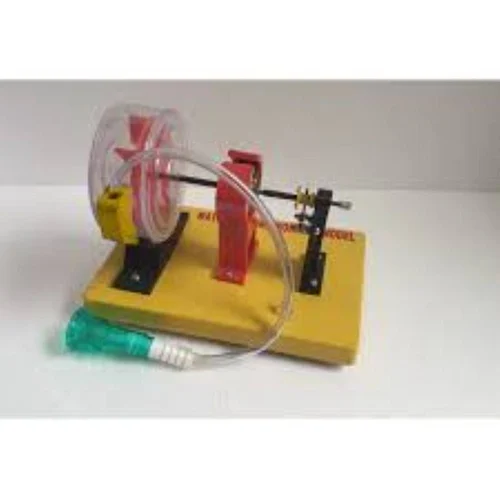
A water turbine working model demonstrates converting water’s energy (potential/kinetic) into mechanical rotation, then into electricity using a connected generator, showcasing hydropower principles for science projects, educational displays, and basic power generation, powering small LEDs or bulbs to teach about renewable energy and real-world hydroelectric dams.
Description
The Water Turbine Working Model is an educational and demonstration apparatus designed to show how the energy of flowing water converts into mechanical rotation and then into electrical energy. It clearly explains the basic working principle of hydropower, which forms the foundation of large hydroelectric dams. As a result, students can visually connect renewable energy theory with real-world power generation.
Schools, colleges, and science exhibition organizers across India commonly use water turbine models for physics and environmental science education. In addition, educational institutions in countries such as the United Kingdom, South Africa, and Kenya rely on these models to teach sustainable energy concepts through hands-on learning.
Water Turbine Working Model for Energy Conversion Learning
The Water Turbine Working Model demonstrates how water’s potential and kinetic energy cause turbine blades to rotate. When water flows over or through the turbine, it produces mechanical motion. Teachers use this model to explain how turbines harness water flow efficiently. Therefore, students clearly understand the first stage of hydropower generation.
Because the turbine connects to a small generator, the rotating motion produces electrical energy. Moreover, learners can observe this output directly when the model powers LEDs or small bulbs, which reinforces the concept of energy transformation.
Water Turbine Working Model for Hydropower and Renewable Energy Education
The Water Turbine Working Model plays a key role in teaching renewable and sustainable energy concepts. Educators use it to explain how hydroelectric dams generate electricity without burning fossil fuels. Consequently, students understand the environmental benefits of hydropower, including reduced pollution and long-term energy sustainability.
The model also supports comparison between different turbine types and water flow conditions. As a result, learners gain insight into how design and flow rate influence power output in real hydroelectric systems.
Simple Design and Classroom-Friendly Operation
The model features a clear and stable structure that allows smooth water flow and turbine rotation. Additionally, the components remain visible during operation, which supports effective explanation during demonstrations. The compact design makes it easy to use in classrooms, labs, and science fairs.
Suitable for Education and Demonstration Use
This water turbine working model is suitable for school science laboratories, colleges, renewable energy demonstrations, science exhibitions, and project-based learning activities. It supports curriculum-aligned teaching in physics, environmental science, and basic engineering.
Applications
- Demonstrating hydropower generation principles
- Teaching energy conversion concepts
- Renewable energy and sustainability education
- Science projects and exhibitions
- Classroom demonstrations and STEM learning

For institutions and laboratories planning to expand their scientific infrastructure, a wide range of biology laboratory instruments and teaching aids is available at
https://www.aseducationalkits.com/products-category/biology-lab-equipments/
In addition, educators and procurement teams can explore a broader selection of educational science items and classroom resources at
https://www.labscientificequipments.com/product-category/educational-items/
See also different:
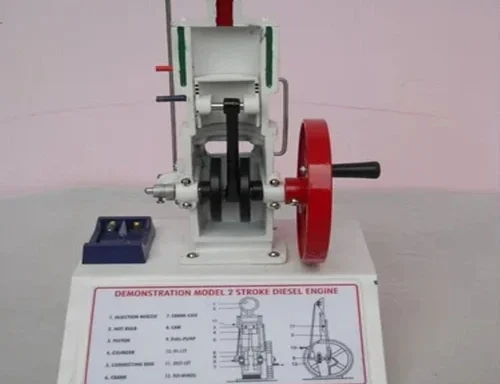
2 Stroke Diesel Engine Model

Solar Bulb Model
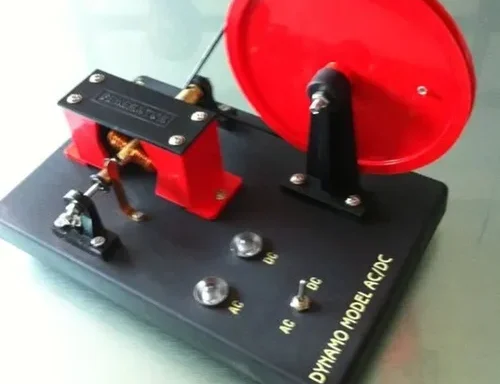
AC/DC Dynamo Model

Earthworm Dissection Model