Two-stroke diesel engines are used where high power-to-weight and simplicity are key, primarily in large marine vessels (ships, tugboats), heavy machinery, and industrial generators, as well as for historical use in some locomotives and trucks, providing robust power but facing pollution challenges for smaller uses. Their design, completing a power cycle in two strokes, offers compactness and frequent power pulses, making them efficient for continuous, heavy-duty work, unlike smaller 2-stroke petrol engines used in chainsaws or mopeds.
Description
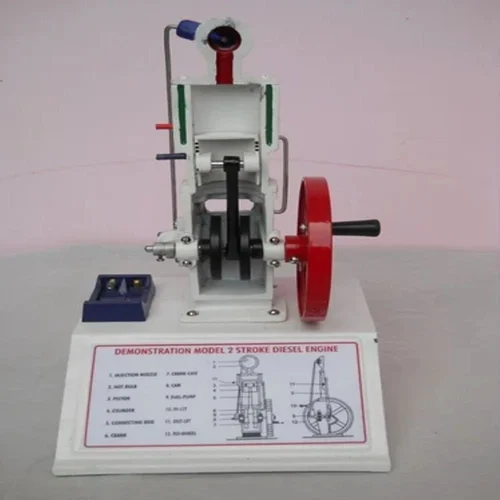
The 2 Stroke Diesel Engine Model is a specialized educational and demonstration tool designed to explain the working principle and applications of two-stroke diesel engines. It helps students and trainees understand how a complete power cycle occurs in just two strokes of the piston. As a result, learners can clearly see why these engines deliver high power output and continuous torque for heavy-duty operations.
Engineering colleges, technical institutes, and marine training centers across India commonly use this model for mechanical and automotive education. In addition, institutions in countries such as the United Kingdom, South Africa, and Kenya rely on diesel engine models to explain large-scale industrial and marine power systems.
2 Stroke Diesel Engine Model for Understanding Engine Working
The 2 Stroke Diesel Engine Model demonstrates how intake, compression, combustion, and exhaust processes occur within a single crankshaft revolution. Unlike four-stroke engines, this design produces a power stroke every revolution. Therefore, the engine delivers higher power-to-weight ratio and smoother operation under continuous load.
Teachers use the model to explain scavenging, fuel injection timing, and piston movement in a simplified and visible manner. Consequently, students can visualize internal processes that are otherwise hidden inside real engines.
2 Stroke Diesel Engine Model for Heavy-Duty Applications Study
The 2 Stroke Diesel Engine Model also helps explain why two-stroke diesel engines remain popular in large marine vessels, industrial generators, and heavy machinery. These engines offer compact construction, mechanical simplicity, and high efficiency during long-duration operation. As a result, they suit ships, tugboats, and stationary power systems where reliability matters more than compact emissions control.
The model further allows discussion on historical use in locomotives and trucks. At the same time, instructors can explain why pollution and emission challenges limit their use in smaller modern vehicles. This balanced explanation strengthens conceptual understanding.
Durable Construction and Classroom-Friendly Design
The model features a robust build that supports repeated classroom demonstrations. Additionally, clearly marked components such as piston, cylinder, crankshaft, and ports improve clarity during instruction. The stable base allows safe tabletop use during lectures and labs.
Suitable for Education and Technical Demonstration
This 2 stroke diesel engine model is suitable for engineering colleges, polytechnic institutes, marine training centers, vocational schools, and mechanical workshops. It supports both theoretical explanation and practical demonstration of engine mechanics.
Applications
- Teaching two-stroke diesel engine working principles
- Understanding power cycles and scavenging
- Mechanical and marine engineering education
- Industrial engine and generator training
- Classroom demonstrations and technical labs
For institutions and laboratories planning to expand their scientific infrastructure, a wide range of biology laboratory instruments and teaching aids is available at
https://www.aseducationalkits.com/products-category/biology-lab-equipments/
In addition, educators and procurement teams can explore a broader selection of educational science items and classroom resources at
https://www.labscientificequipments.com/product-category/educational-items/