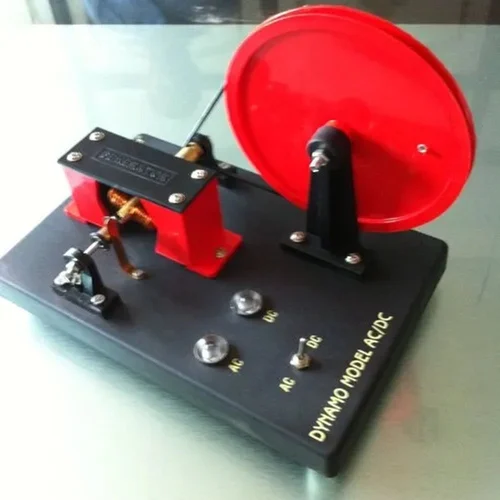
AC/DC Dynamo Models are primarily used in physics education to demonstrate electromagnetic induction, showing how mechanical energy converts to electrical energy, producing both Alternating Current (AC) via slip rings and Direct Current (DC) via a commutator, making them essential tools for visualizing generator principles and comparing AC/DC differences in schools and labs.
Description
The AC/DC Dynamo Model is an essential educational apparatus used in physics laboratories to demonstrate the principle of electromagnetic induction. It clearly shows how mechanical energy converts into electrical energy through rotation in a magnetic field. As a result, students can visually understand the basic working of electrical generators in a simple and practical manner.
Schools, colleges, and teacher training institutes across India widely use AC/DC dynamo models for physics demonstrations. In addition, educational institutions in countries such as the United Kingdom, South Africa, and Kenya rely on these models to explain generator principles and current types effectively.
AC/DC Dynamo Model for Electromagnetic Induction Learning
The AC/DC Dynamo Model helps students understand Faraday’s law of electromagnetic induction by showing how rotating a coil within a magnetic field produces an electric current. Teachers use the model to explain the relationship between motion, magnetic fields, and electricity. Therefore, learners can clearly link theory with observable results.
Because the model operates manually or with a small drive mechanism, students can directly control rotation speed. Moreover, this hands-on interaction helps them see how changes in speed affect electrical output.
AC/DC Dynamo Model for Comparing AC and DC Generation
The AC/DC Dynamo Model uniquely demonstrates the difference between Alternating Current (AC) and Direct Current (DC). Using slip rings, the model produces AC, where current direction changes periodically. Using a commutator, it produces DC, where current flows in a single direction. Consequently, students can easily compare the construction and output of both systems side by side.
This comparison strengthens understanding of why AC is used for power transmission and why DC is preferred in batteries and electronic devices. As a result, learners develop a strong conceptual foundation in electrical engineering basics.
Simple Construction and Classroom-Friendly Design
The model features clearly visible components such as coils, magnets, slip rings, and commutators. Additionally, the sturdy base ensures stable operation during demonstrations. The simple design allows repeated classroom use without complex maintenance.
Suitable for Education and Demonstration Use
This AC/DC dynamo model is suitable for school physics laboratories, colleges, science exhibitions, engineering foundation courses, and teacher training programs. It supports curriculum-aligned teaching and practical exam preparation.
Applications
- Demonstrating electromagnetic induction
- Explaining electrical generator principles
- Comparing AC and DC current generation
- Physics classroom demonstrations
- Practical learning in electricity and magnetism
For institutions and laboratories planning to expand their scientific infrastructure, a wide range of biology laboratory instruments and teaching aids is available at
https://www.aseducationalkits.com/products-category/biology-lab-equipments/
In addition, educators and procurement teams can explore a broader selection of educational science items and classroom resources at
https://www.labscientificequipments.com/product-category/educational-items/