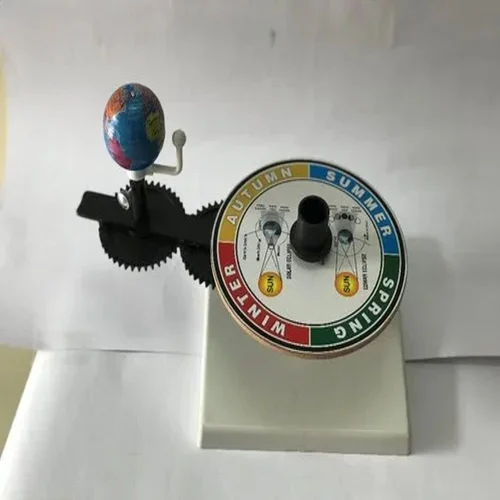
Solar and lunar eclipse models are primarily educational tools used in STEM to visually demonstrate celestial mechanics, showing how the Sun, Earth, and Moon align to cast shadows, explaining concepts like umbra/penumbra, syzygy, and the Blood Moon, making complex orbital dynamics interactive and easy for students to grasp through hands-on learning and observation.
Description
The Solar Lunar Eclipse Model is an interactive educational apparatus designed to explain how eclipses occur through the alignment of the Sun, Earth, and Moon. It visually demonstrates celestial mechanics in a clear and engaging way, allowing students to observe how shadows form and move during eclipse events. As a result, complex astronomical concepts become accessible through hands-on learning and direct observation.
Schools, colleges, and science centers across India commonly use solar lunar eclipse models in astronomy and earth science classes. In addition, educational institutions in countries such as the United Kingdom, South Africa, and Kenya rely on these models to support STEM education and concept-based learning.
Solar Lunar Eclipse Model for Understanding Eclipse Formation
The Solar Lunar Eclipse Model helps students understand the difference between solar and lunar eclipses by showing real-time alignment scenarios. When the Moon comes between the Sun and the Earth, the model demonstrates a solar eclipse. Conversely, when the Earth moves between the Sun and the Moon, it shows a lunar eclipse. Therefore, learners can clearly distinguish between the two phenomena.
Because the model highlights shadow regions, teachers can explain concepts such as umbra and penumbra in a visual manner. Moreover, students can observe how partial and total eclipses occur based on alignment and distance.
Solar Lunar Eclipse Model for Celestial Mechanics and Orbital Learning
The Solar Lunar Eclipse Model also supports understanding of broader celestial mechanics. Educators use it to explain orbital motion, syzygy, and the inclination of the Moon’s orbit. Consequently, students gain insight into why eclipses do not occur every month.
The model also helps explain special events such as the Blood Moon during total lunar eclipses. As a result, learners can connect theoretical explanations with observable astronomical events.
Interactive Design for Classroom Demonstration
The model features clearly marked components representing the Sun, Earth, and Moon. Additionally, its stable structure allows smooth movement and repeated classroom demonstrations. This interactive setup encourages student participation and inquiry-based learning.
Suitable for Education and Demonstration Use
This solar lunar eclipse model is suitable for school classrooms, science laboratories, astronomy clubs, teacher training institutes, and science exhibitions. It aligns well with curricula covering astronomy, earth science, and basic space science concepts.
Applications
- Demonstrating solar and lunar eclipses
- Understanding umbra and penumbra
- Teaching celestial alignment and syzygy
- Astronomy and earth science education
- Classroom demonstrations and science fairs
For institutions and laboratories planning to expand their scientific infrastructure, a wide range of biology laboratory instruments and teaching aids is available at
https://www.aseducationalkits.com/products-category/biology-lab-equipments/
In addition, educators and procurement teams can explore a broader selection of educational science items and classroom resources at
https://www.labscientificequipments.com/product-category/educational-items/