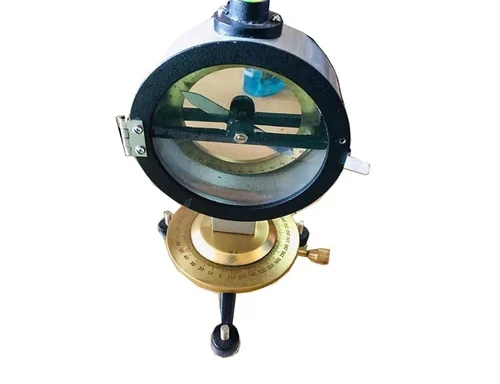

A Planck’s Constant Apparatus measures “h” by using LEDs or a phototube with filters to determine the energy of photons, plotting photon energy (E=hfcap E equals h f𝐸=ℎ𝑓) against frequency (ff𝑓) to find the slope, which reveals Planck’s constant; the core process involves measuring the threshold voltage (stopping potential) where light starts causing current or light emission, correlating this voltage to photon energy, and graphing the data for analysis, often with an ammeter for precision.
Description
A Planck’s Constant Apparatus measures “h” by using LEDs or a phototube with filters to determine the energy of photons, plotting photon energy (E=hfcap E equals h f𝐸=ℎ𝑓) against frequency (ff𝑓) to find the slope, which reveals Planck’s constant; the core process involves measuring the threshold voltage (stopping potential) where light starts causing current or light emission, correlating this voltage to photon energy, and graphing the data for analysis, often with an ammeter for precision.