A magnetic dip circle is a precision scientific instrument designed for educational and laboratory environments where the measurement and study of the Earth’s magnetic field is essential. This device is widely used in physics laboratories, research settings, and academic institutions to demonstrate the concept of magnetic inclination or dip, which is the angle made by the Earth’s magnetic field lines with the horizontal plane. By allowing students to observe this natural phenomenon through direct measurement, the magnetic dip circle helps build a practical understanding of geomagnetism, vector fields, and magnetic forces in the Earth’s environment. Its intuitive design makes it an effective tool for both introductory demonstrations and advanced experimental applications.
Description
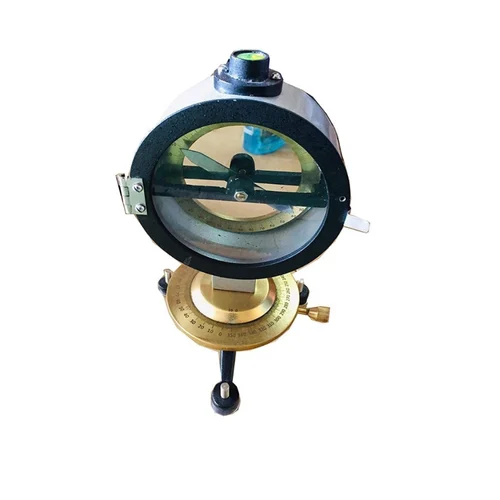
The instrument typically consists of a lightweight yet durable frame that supports a highly sensitive magnetic needle mounted so that it can rotate freely in a vertical plane. This free rotation is crucial for accurately determining the dip angle. The needle is carefully balanced and magnetized to ensure a stable response to the Earth’s magnetic field. The structure is compact, usually measuring around 18 x 19 x 20 cm, making it easy to place on laboratory benches and transport between classrooms or demonstration areas. Despite its portable size, it delivers precise readings, which is critical for teaching accuracy and repeatability in scientific measurements. With a weight of approximately 200 grams, the device is easy to handle yet sturdy enough for regular educational use.
A calibrated circular scale surrounds the needle, allowing users to read measurements directly and clearly. This scale is typically marked in degrees to give students a straightforward way to interpret the dip angle. The simplicity of the scale promotes ease of learning, ensuring that students can quickly grasp how changes in the needle’s position relate to variations in magnetic inclination at different locations. The pivot mechanism at the center of the instrument is engineered for smooth and minimal-friction movement. This ensures that even small variations in magnetic forces can be detected, providing accurate and reliable results during classroom demonstrations or experimental sessions.
The magnetic dip circle is commonly used in earth science, physics, and geophysics courses to help students explore the relationship between horizontal and vertical components of the Earth’s magnetic field. By rotating the device about its axis, learners can align the needle with the magnetic meridian and then observe the resulting dip angle. This hands-on interaction deepens their understanding of geographic variation in magnetic fields and the factors that influence these variations. The device also supports experiments involving induced magnetism, field mapping, and comparisons between theoretical predictions and empirical measurements.
Built for long-term academic use, the magnetic dip circle is constructed with materials that resist wear and maintain calibration over time. Its compact design and stable base make it ideal for repeated classroom handling. Educators value this instrument for its ability to transform abstract geomagnetic concepts into clear, interactive learning experiences. As a result, it stands as an essential piece of educational equipment for schools, colleges, and technical institutes seeking to strengthen practical understanding of magnetic phenomena.