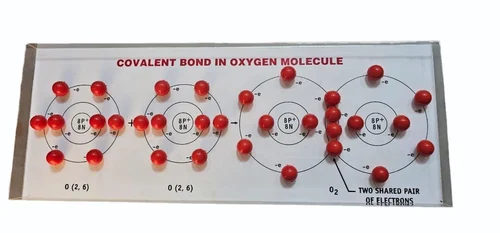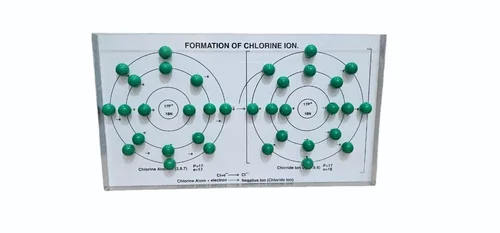
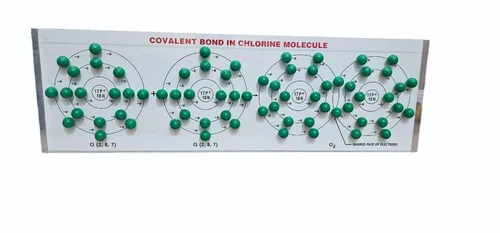
The Covalent Bond Chlorine Molecule Model plastic is a visually engaging and educational tool designed to demonstrate the concept of covalent bonding, specifically in chlorine (Cl₂) molecules. This working model is an essential aid for school science education, particularly in chemistry lessons that cover molecular structures, chemical bonding, and electron sharing. The model measures approximately 5 x 12 inches, making it the ideal size for classroom demonstrations, individual student learning, and science exhibitions.
Description
The Covalent Bond Chlorine Molecule Model Plastic is an educational science model designed to help students understand the concept of covalent bonding in diatomic molecules. It visually represents how two chlorine atoms share electrons to form a stable chlorine molecule (Cl₂). Therefore, this model serves as an effective teaching aid for explaining atomic interactions and molecular formation in school chemistry classes.
Structure and Visual Representation of the Model
The Covalent Bond Chlorine Molecule Model Plastic features two chlorine atoms displayed in distinct green and white colors. This color-coded design allows students to easily identify the atoms involved in the bond and understand how identical atoms form a covalent bond. Because the model clearly shows the shared electron pair between the atoms, learners can visualize the bonding process that holds the molecule together.
This physical representation simplifies abstract chemical concepts. Instead of relying solely on textbook diagrams, students can observe how atoms share electrons to achieve stability. As a result, the learning process becomes more interactive and engaging.
Demonstrating the Octet Rule and Molecular Stability
The Covalent Bond Chlorine Molecule Model Plastic is particularly useful for explaining the octet rule, which states that atoms tend to achieve a stable electron configuration by sharing or transferring electrons. In this model, each chlorine atom contributes one electron to create a shared pair. Consequently, both atoms achieve stable outer electron shells.
Teachers can also use the model to explain additional topics such as bond formation, molecular polarity, and bond strength. Because the structure clearly illustrates the single covalent bond in chlorine molecules, students can easily connect theoretical concepts with visual demonstrations.
Durable and Student-Friendly Construction
The Covalent Bond Chlorine Molecule Model Plastic is made from high-quality plastic that ensures durability and long-term use in classrooms and laboratories. Its lightweight design allows easy handling during demonstrations and group learning activities. Moreover, the smooth surface and sturdy construction provide safety for students while maintaining clarity in structural representation.
The compact size makes the model convenient for storage and transportation. Therefore, educators can easily use it in classroom lectures, laboratory sessions, science exhibitions, and academic presentations.
Applications in Chemistry Education
The Covalent Bond Chlorine Molecule Model Plastic is widely used in middle and high school chemistry classes to demonstrate molecular bonding. It helps teachers explain topics such as atomic structure, electron sharing, and molecular formation. In addition, students often use it in science fairs and educational demonstrations to illustrate chemical bonding principles.
Because the model transforms theoretical chemistry into a physical visual aid, it supports inquiry-based learning and improves student comprehension. Consequently, learners develop a stronger foundation in molecular chemistry.
Importance in Interactive STEM Learning
The Covalent Bond Chlorine Molecule Model Plastic bridges the gap between abstract scientific theory and practical visualization. By presenting molecular bonding in a clear and interactive format, it enhances understanding and knowledge retention. As a result, teachers can effectively communicate complex chemical principles while keeping students actively engaged.
This model remains an essential resource for science classrooms and laboratories focused on improving STEM education through hands-on learning experiences.
For related laboratory and educational equipment, you may explore:
https://www.aseducationalkits.com/products-category/physics-lab-equipment/
For a broader range of laboratory and analytical solutions, professionals can also refer to:
https://interlabs.in/products-catalogue/