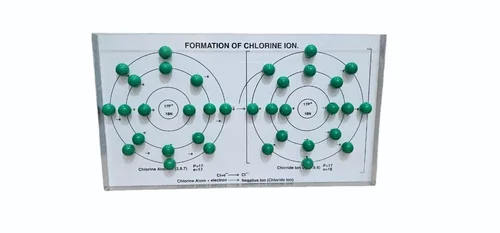
The Plastic Chemistry Chlorine Ion Model is an essential educational tool designed to simplify the understanding of ionic bonding, specifically the formation of the chlorine ion. Made from durable plastic, this 2D model is tailored for use in chemistry classrooms, science laboratories, and educational demonstrations targeting students from classes 9 to 12. With a focus on academic clarity and interactive learning, the model provides a clear representation of the electronic configuration and the transformation of a chlorine atom into a chloride ion. It serves as an effective aid for teachers and learners to visualize atomic structure, electron transfer, and the resulting ionic charge.
Description
The Chlorine Ion Model is an educational chemistry model designed to help students understand how atoms gain or lose electrons to form ions. It visually represents the formation of a chloride ion (Cl⁻) when a chlorine atom gains one electron to achieve a stable electron configuration. Because ionic bonding and ion formation can be difficult concepts for beginners, this model provides a clear and interactive way for students to explore these ideas in classrooms and laboratories.
Structure and Representation of the Chlorine Ion
The Chlorine Ion Model accurately displays the outer shell of a chlorine atom, highlighting the seven valence electrons present in its outermost energy level. This representation shows that chlorine is one electron short of completing its octet. As a result, the atom has a strong tendency to gain one additional electron.
When chlorine accepts an extra electron, it forms a negatively charged ion known as the chloride ion (Cl⁻). The model demonstrates this transformation visually, helping learners understand how atoms change their electronic structure during chemical reactions. Therefore, students can clearly observe how chlorine achieves stability by completing its outer electron shell.
Demonstrating Ionic Bond Formation
The Chlorine Ion Model is particularly useful for explaining ionic bonding. In ionic reactions, non-metal atoms such as chlorine gain electrons from metal atoms. For example, in the formation of sodium chloride (NaCl), a sodium atom transfers one electron to a chlorine atom. Consequently, sodium becomes a positively charged ion (Na⁺) while chlorine becomes a negatively charged chloride ion (Cl⁻).
This model allows teachers to visually demonstrate the electron transfer process that leads to ionic bond formation. Students can better understand how opposite charges attract and form stable ionic compounds.
Educational Value in Chemistry Learning
The Chlorine Ion Model supports effective science education by transforming theoretical chemical concepts into visual demonstrations. Through hands-on observation, students gain a clearer understanding of topics such as atomic structure, valence electrons, and ion formation.
Teachers frequently use this model during lessons on electrovalent bonding, periodic trends, and chemical reactivity. In addition, it can be used during science exhibitions, laboratory demonstrations, and classroom discussions to illustrate the behavior of halogens in chemical reactions.
Durable Construction and Classroom Use
The Chlorine Ion Model is manufactured using high-quality plastic that ensures durability and long-term usability in educational environments. The material is lightweight, non-toxic, and resistant to wear, making it safe for regular classroom handling.
Its smooth surface and clearly structured design improve visibility during demonstrations, even for larger classroom groups. Furthermore, the compact and portable structure allows teachers to easily store and transport the model between classrooms or laboratory sessions.
Supporting Interactive STEM Education
The Chlorine Ion Model aligns with modern teaching approaches that emphasize visual learning and student engagement. By presenting atomic interactions in a tangible format, the model encourages discussion, inquiry, and collaborative learning among students.
Students can use the model to explore related concepts such as electronegativity, ionization energy, periodic table trends, and the chemical properties of halogens. Consequently, it strengthens their understanding of fundamental chemistry principles and prepares them for more advanced topics in chemical bonding and molecular structure.
Importance in Science Teaching
The Chlorine Ion Model serves as a practical teaching tool that bridges the gap between textbook theory and real scientific understanding. By clearly demonstrating how chlorine atoms gain electrons to form stable ions, it helps students grasp the fundamentals of ionic chemistry more effectively.
Because of its durability, clarity, and educational value, this model remains an important addition to school laboratories and chemistry classrooms focused on improving conceptual learning.
For related laboratory and educational equipment, you may explore:
https://www.aseducationalkits.com/products-category/physics-lab-equipment/
For a broader range of laboratory and analytical solutions, professionals can also refer to:
https://interlabs.in/products-catalogue/