
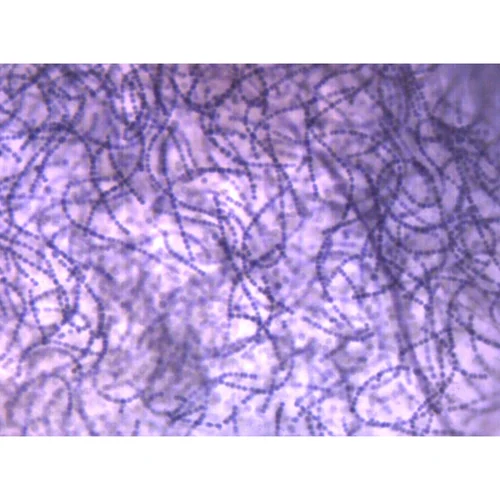
The permanent slide of Nostoc is a professionally prepared microscopic specimen that provides a detailed view of this fascinating genus of cyanobacteria, also known as blue-green algae. Nostoc is a filamentous, photosynthetic microorganism found in a variety of moist environments, including soil, freshwater bodies, and symbiotic associations with plants such as cycads. This permanent slide captures the intricate structure of Nostoc colonies, which consist of chains of rounded cells called trichomes embedded within a gelatinous sheath. The slide offers a clear and magnified visualization of the vegetative cells responsible for photosynthesis, as well as heterocysts, which are specialized nitrogen-fixing cells that play a crucial role in converting atmospheric nitrogen into forms usable by plants. The specimen is stained and mounted with precision to highlight these features, allowing for a vivid and accurate representation of the organism’s cellular organization and functional adaptations.
Description
Under the microscope, this slide reveals the unique bead-like arrangement of Nostoc cells, their surrounding mucilaginous matrix, and the distinction between heterocysts and vegetative cells. This makes it an invaluable tool for understanding both the morphology and ecological significance of cyanobacteria. The preparation preserves the natural characteristics of Nostoc while enhancing visibility through selective staining techniques, enabling students, educators, and researchers to observe its structural details without the degradation that occurs in temporary mounts. The durability of this slide ensures repeated use for years, making it an essential resource for classrooms, laboratories, and scientific study.
Educationally, the permanent slide of Nostoc serves as an excellent aid for teaching and learning microbiology, phycology, and environmental biology. It helps illustrate fundamental biological concepts such as photosynthesis in prokaryotes, nitrogen fixation, and the role of cyanobacteria in ecosystems. By observing this slide, students can gain a deeper understanding of how microorganisms contribute to nutrient cycling, soil fertility, and the maintenance of ecological balance. It also provides insight into the evolutionary significance of cyanobacteria, which are among the earliest photosynthetic organisms on Earth and have played a pivotal role in shaping the planet’s atmosphere.
In academic settings, this slide supports the study of prokaryotic cell structure, bacterial diversity, and symbiotic relationships. It is particularly useful in explaining the mutualistic association Nostoc forms with certain plants, wherein the cyanobacterium supplies nitrogen while receiving carbohydrates and protection from its host. The presence of heterocysts is a key feature that can be easily examined on this slide, demonstrating how structural specialization enables specific biological functions. Such observations are critical for understanding microbial adaptation and functional morphology in various environmental conditions.
The slide is mounted on durable glass with a securely sealed cover slip to prevent contamination, moisture damage, and deterioration, ensuring long-lasting clarity and usability. The precision in preparation ensures that even fine details of the Nostoc colonies remain intact and easily observable, making it an indispensable resource for long-term educational and research purposes.
Whether used in school biology classes, college laboratories, or specialized research facilities, the permanent slide of Nostoc offers a clear, detailed, and lasting representation of this ecologically and scientifically significant cyanobacterium. It stands as an essential tool for exploring the microscopic world, helping learners and researchers alike appreciate the complexity and importance of these remarkable microorganisms.