
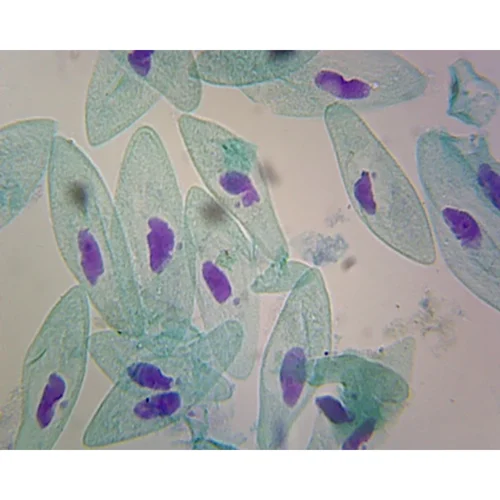
The permanent slide of Paramecium is a highly valuable microscopic specimen that provides a clear and detailed view of one of the most well-known unicellular organisms. Paramecium, often referred to as the “slipper animalcule” due to its distinctive slipper-like shape, belongs to the group of ciliates and is widely studied in biology and microbiology for its unique structure and fascinating life processes. This permanent slide is carefully prepared using professional techniques that ensure the organism is preserved in fine detail, enabling long-term use without deterioration. The specimen is permanently mounted on a durable glass slide, sealed with a cover slip to protect it from external damage, contamination, and moisture, making it an ideal teaching and research tool for schools, colleges, and laboratories.
Description
Paramecium is an excellent model organism for microscopic study because of its complex yet easily visible cellular features. Under the microscope, this permanent slide highlights the characteristic elongated body covered with fine hair-like structures called cilia. These cilia are used for locomotion as well as for directing food particles into the oral groove, demonstrating how a unicellular organism is capable of efficient movement and feeding. The slide also allows clear visualization of key internal structures such as the macronucleus, which regulates metabolic and developmental functions, and the micronucleus, which plays a vital role in reproduction. With appropriate magnification, one can also observe contractile vacuoles, which maintain osmotic balance by expelling excess water, and food vacuoles, where ingested food particles are digested. This combination of external and internal features makes the permanent slide of Paramecium an essential specimen for understanding protozoan biology.
The preparation of this slide ensures that the organism retains its shape and structure, allowing repeated observations without loss of clarity. Special staining methods are often employed to highlight important organelles and cellular structures, enabling learners to differentiate between the nucleus, vacuoles, cytoplasm, and other internal features. The accuracy of the staining and mounting process provides a high-quality visual experience for students and researchers, ensuring that every detail of Paramecium’s cellular complexity is preserved for long-term study. Because it is a permanent preparation, this slide eliminates the need for live cultures, which can be time-consuming and difficult to maintain, while still offering all the benefits of detailed microscopic examination.
Educationally, the permanent slide of Paramecium is an essential resource in biology classrooms and laboratories. It allows students to study locomotion, feeding, osmoregulation, and reproduction in protozoa with clarity, enhancing their understanding of cell biology and the diversity of life at the microscopic level. The slide is often used in lessons covering topics such as protozoa, unicellular organisms, the role of cilia, and the structural adaptations of single-celled eukaryotes. By observing Paramecium under the microscope, learners gain a deeper appreciation of how a single cell can perform all the vital functions of life, from movement and nutrition to excretion and reproduction.
This permanent slide is compatible with standard compound microscopes and provides excellent resolution, making it suitable for both basic and advanced levels of study. For students, it is an engaging way to connect theoretical knowledge with practical observation, reinforcing fundamental concepts in cell biology and microbiology. Durable, clear, and meticulously prepared, the permanent slide of Paramecium is a must-have specimen for anyone seeking to explore the fascinating world of unicellular life and understand the structural and functional diversity of protozoa.