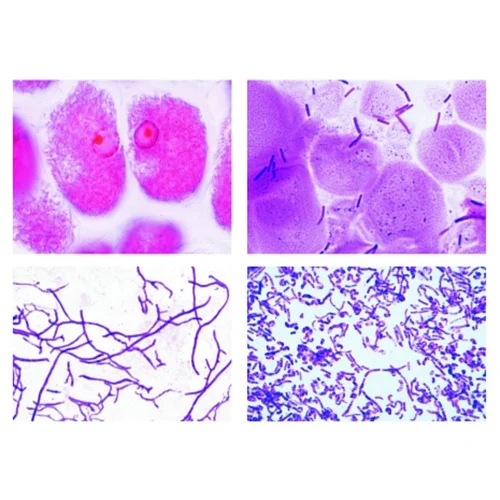
The permanent slide of bacteria featuring Cocci, Bacilli, Vibrio, and Spirillum is a meticulously prepared microscopic specimen designed to showcase the diversity of bacterial shapes and structures in exceptional clarity. This slide offers an invaluable resource for the study of microbiology, allowing observers to identify and compare these four major bacterial morphologies in a single, durable preparation. Cocci are spherical or oval-shaped bacteria that can occur singly, in pairs, chains, or clusters, playing important roles in both beneficial and pathogenic processes. Bacilli are rod-shaped bacteria known for their versatility and prevalence in a wide range of environments, including soil, water, and within living hosts. Vibrio bacteria are comma-shaped organisms often found in aquatic habitats, some of which have significant roles in marine ecosystems, while others are medically important. Spirillum are spiral or corkscrew-shaped bacteria that exhibit unique motility due to their flagella and can be found in stagnant water and other habitats.
Description
This slide is prepared with precision, using selective staining techniques to differentiate the bacterial forms and enhance their visibility under a microscope. Each type of bacterium is presented in its distinct arrangement, enabling clear observation of its characteristic shape, size, and structural details. The staining highlights features such as cell walls, grouping patterns, and curvature, which are critical for understanding bacterial classification and identification. The preparation is permanently mounted on high-quality glass with a sealed cover slip, ensuring the sample remains intact, uncontaminated, and protected from moisture, dust, and physical damage over time. This durability allows for repeated and long-term use, making the slide ideal for classrooms, laboratories, and research settings.
From an educational perspective, the permanent slide of Cocci, Bacilli, Vibrio, and Spirillum serves as a foundational tool in microbiology studies. It enables students to directly observe the morphological basis of bacterial taxonomy and appreciate the structural diversity among prokaryotes. The visual comparison between the spherical Cocci, elongated Bacilli, curved Vibrio, and spiral Spirillum fosters a deeper understanding of how shape influences bacterial function, adaptation, and ecological niche. For example, the slide can be used to explain how the compact shape of Cocci may aid in resistance to environmental stress, while the elongated form of Bacilli can facilitate nutrient absorption and motility. Similarly, the curved Vibrio shape is often linked to specific ecological adaptations in aquatic environments, and the helical Spirillum design supports rapid movement through viscous media.
The slide also serves as an important reference for understanding the medical and ecological significance of bacteria. By observing these forms, learners can connect theoretical knowledge about bacterial pathogens, beneficial microbes, and environmental bacteria to their actual microscopic appearance. It is particularly valuable in explaining laboratory diagnostic techniques, such as Gram staining and bacterial culture interpretation, where morphology plays a key role in initial identification.
With its clarity, durability, and precise preparation, this permanent slide offers a reliable and accurate representation of bacterial diversity. It is compatible with all standard light microscopes, providing consistent high-resolution views that facilitate both teaching and research. Whether used in school biology courses, university microbiology programs, or professional laboratories, the permanent slide of Cocci, Bacilli, Vibrio, and Spirillum is an essential educational tool, enabling learners to explore the microscopic world and appreciate the structural variety, adaptability, and significance of bacteria in nature and health sciences.