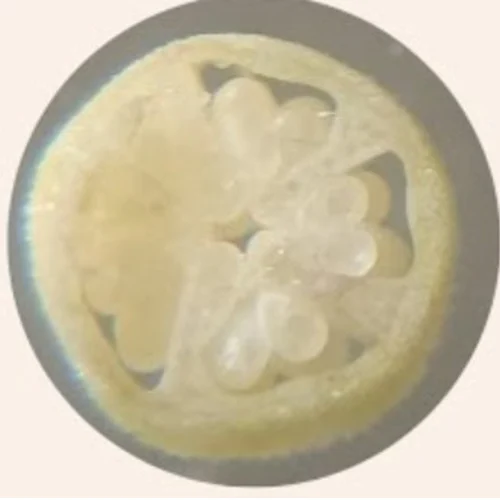
The permanent slide of the T.S. (transverse section) of the ovule of Hibiscus is a meticulously prepared and preserved botanical specimen designed to provide a clear and detailed microscopic view of the internal structure of the ovule in one of the most studied flowering plants. This high-quality educational slide is an essential tool for students, teachers, and researchers in the fields of botany, plant anatomy, and reproductive biology. Hibiscus, belonging to the family Malvaceae, is widely used in plant science education due to its well-defined floral structure, and the ovule plays a crucial role in the plant’s reproductive cycle. By examining this transverse section under a microscope, learners can gain a comprehensive understanding of the anatomy and function of the ovule, which is the structure that develops into a seed after fertilization.
Description
The specimen on the slide is carefully sectioned to reveal the intricate internal arrangement of tissues within the Hibiscus ovule. The staining process used in preparation enhances the contrast between different cell types and tissues, making structures such as the integuments, nucellus, micropyle, and embryo sac clearly distinguishable. The precision of the sectioning ensures that the specimen retains its natural morphology, allowing observers to study features such as the orientation of the ovule, the protective outer layers, and the position of the female gametophyte. The clarity of the slide makes it an ideal reference for identifying and labeling these key components during academic examinations and laboratory exercises.
This permanent slide is particularly useful in teaching plant reproductive biology, as it allows educators to explain complex processes like megasporogenesis, megagametogenesis, and fertilization with direct visual support. By observing the T.S. of the Hibiscus ovule, students can better understand how the protective layers safeguard the female gametophyte, how the micropyle facilitates pollen tube entry, and how the embryo sac serves as the site of fertilization and early embryonic development. The detailed view provided by this slide supports curriculum topics in botany for high school, undergraduate, and postgraduate studies, making it a versatile resource for a variety of educational levels.
Mounted on a durable glass slide with a protective cover slip, the specimen is sealed to prevent deterioration, ensuring long-term use without loss of clarity. It is compatible with all standard optical microscopes and can also be observed through advanced imaging systems for digital projection in classrooms or online teaching environments. The slide is prepared with precision to ensure that every critical anatomical detail remains intact and visible, making it an invaluable teaching aid for repeated use over many years.
In addition to classroom applications, the permanent slide of the T.S. of the Hibiscus ovule is a valuable asset for research laboratories studying angiosperm reproduction, plant anatomy, or seed development. The ovule’s structure in Hibiscus provides a representative model for understanding similar reproductive processes in other flowering plants, which is beneficial for comparative botanical studies. Whether used for academic demonstrations, lab practicals, or advanced research, this slide offers a highly accurate, detailed, and durable representation of one of the most essential reproductive structures in plants, making it an indispensable resource for deepening knowledge of plant biology and reproduction.