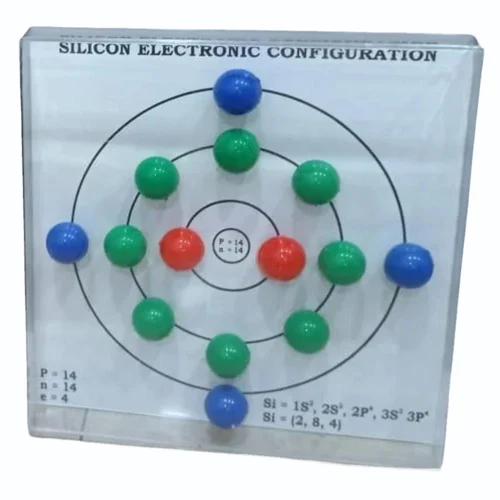
The Silicon Electronic Configuration School Project Model is an educational and visually engaging tool designed to help students understand the atomic structure and electron arrangement of the element silicon. Constructed using high-quality materials, this model offers a clear and interactive representation of the electronic configuration of silicon, making it ideal for science exhibitions, classroom demonstrations, and self-guided learning projects. With its compact 10 x 10 inch square shape and clean white color, the model provides a structured and easy-to-follow layout for students to grasp the abstract concepts of atomic structure, sub-shell filling, and electron distribution.
Description
This working model focuses specifically on silicon, a vital element in the periodic table with the atomic number 14. The model effectively illustrates how the 14 electrons of a silicon atom are arranged across different energy levels and orbitals. It displays the classic electronic configuration of silicon as 2, 8, 4, demonstrating that the element has two electrons in the first shell, eight in the second, and four in the third shell. This configuration is essential for students to understand silicon’s chemical properties, bonding behavior, and significance in the field of semiconductors and electronics.
Designed for school-level science education, the Silicon Electronic Configuration Model is both sturdy and lightweight, ensuring durability while being easy to handle during demonstrations or exhibitions. Its white surface provides a clear background that enhances the visibility of the orbitals and electron positions, allowing teachers and students to interact with the model without confusion. The use of contrasting indicators to represent electrons makes it easier to differentiate between shells and visualize the gradual filling of orbitals according to the Aufbau principle, Pauli exclusion principle, and Hund’s rule.
The educational value of this model extends beyond just showing electron placement. It serves as a gateway for discussing atomic theory, chemical bonding, valency, and periodic trends. Teachers can use the model to explain how silicon forms covalent bonds by sharing its four valence electrons and why it is a crucial element in forming complex compounds such as silicon dioxide (SiO₂) and silicones. Additionally, students are able to relate this knowledge to real-world applications in electronics, where silicon is widely used in integrated circuits and photovoltaic cells due to its semiconductor properties.
With its square layout and labeled structure, the model encourages visual learning and improves retention of concepts related to atomic structure and periodic classification. It fits seamlessly into school curriculums for classes ranging from middle to senior secondary levels. Its simplicity and clarity make it especially suitable for younger students who are being introduced to atomic models for the first time, while its technical accuracy ensures that it remains a reliable reference for advanced learners as well.
In conclusion, the Silicon Electronic Configuration School Project Model is a valuable resource for enriching science education. It simplifies complex scientific concepts into a hands-on, engaging, and visually appealing format that helps students gain a solid foundation in chemistry and atomic theory. Its thoughtful design, durability, and educational relevance make it an ideal teaching aid for classrooms, science fairs, and educational displays focused on the structure and behavior of atoms, particularly silicon.