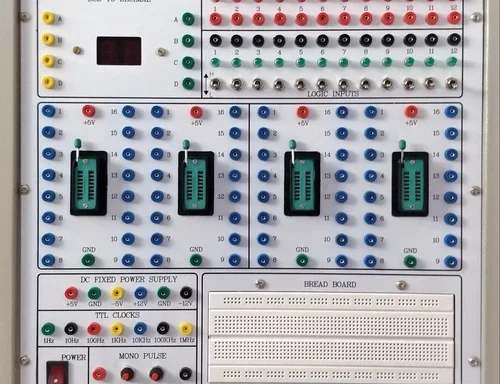
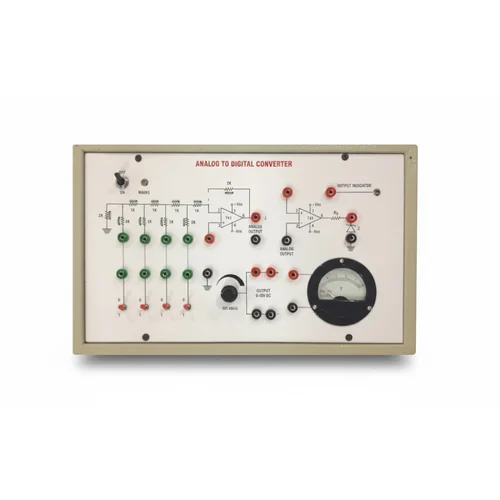
The Analog to Digital Converter apparatus is a comprehensive piece of educational equipment designed for laboratory use to help students understand the fundamental principles of converting analog signals into digital form. Widely used in electronics and instrumentation laboratories, this trainer provides a clear and structured platform for studying analog to digital conversion techniques that form the backbone of modern digital systems. The apparatus operates on selectable DC power supplies of 5, 10, and 15 volts and draws a modest current of approximately 150 mA, ensuring safe and stable operation in academic environments. Designed with a strong metal enclosure, the unit offers durability and long-term reliability, making it suitable for repeated use in teaching laboratories where equipment is handled frequently by multiple users. The system is specifically configured to study analog to digital conversion using the R-2R ladder network and the successive approximation method, allowing learners to explore two widely taught and practically significant conversion techniques in a single setup.
Description
Introduction to Analog To Digital Converter
Analog To Digital Converter is an educational laboratory apparatus designed to demonstrate the process of converting analog signals into digital data. Electronics laboratories widely use this trainer to help students understand how continuous analog signals can be translated into binary numbers used by digital systems.
The front panel of the apparatus features a clearly printed circuit diagram that helps students visualize signal flow and conversion stages. As a result, learners can follow the operation of the circuit without constantly referring to external manuals. This design improves conceptual clarity and reduces setup errors during laboratory experiments.
Engineering colleges, polytechnic institutes, and technical training centers commonly use this apparatus to teach digital electronics, instrumentation, and embedded system concepts.
Working Principle of Analog To Digital Converter
The apparatus operates using common analog-to-digital conversion techniques such as the R-2R resistor ladder network and successive approximation method. These circuits convert an analog voltage into a digital binary output.
Four SPDT switches are provided on the panel to manually select logic states of 1 or 0. Consequently, students can create different binary combinations and observe how the input changes affect the conversion process.
A built-in voltmeter allows accurate measurement of analog input or reference voltage. As a result, learners can compare the analog input with the corresponding digital output displayed on the indicator.
Through these operations, students learn how analog signals from sensors and instruments are converted into digital data used by computers and microcontrollers.
Applications of Analog To Digital Converter
Electronics laboratories commonly use this trainer to study the principles of analog-to-digital conversion. Students can perform experiments related to binary weighting, resolution, and quantization.
Engineering institutes also use this apparatus to demonstrate how ADC systems are used in data acquisition and digital instrumentation. Moreover, the trainer helps learners understand how analog signals from sensors are processed in embedded systems.
This equipment is particularly useful for courses in digital electronics, microprocessors, embedded systems, and control engineering.
Features
This laboratory trainer includes several features that support effective learning and experimentation.
Firstly, the printed circuit diagram on the front panel helps students easily understand signal flow. Secondly, manual input controls allow interactive learning.
Key features include:
- Clearly printed circuit diagram on the front panel
- Four SPDT switches for digital input selection
- Built-in voltmeter for measuring analog input or reference voltage
- Output indicator for digital signal visualization
- R-2R ladder network for accurate voltage generation
- Compact and secure box packaging for laboratory use
These features make the trainer suitable for practical electronics education.
Educational Importance
Understanding analog-to-digital conversion is essential for modern electronic systems. Therefore, laboratories use this trainer to help students connect theoretical concepts with real experiments.
Students learn about binary representation, bit significance, and resolution while observing how analog signals convert into digital outputs. Moreover, they study important performance parameters such as quantization error and conversion accuracy.
Consequently, the trainer strengthens students’ knowledge of mixed-signal electronics and prepares them for advanced topics in instrumentation and signal processing. Educational institutions can also explore additional training kits here:
https://www.aseducationalkits.com/products-category/ncert-educational-kits/
Industrial Uses
Analog-to-digital conversion is widely used in modern electronic devices and industrial systems. Sensors, control systems, and digital measurement instruments all rely on ADC circuits to process analog signals.
Industries such as automation, telecommunications, and embedded system design depend heavily on accurate data conversion technologies. Training and technical education equipment related to skill development can also be explored here:
https://interlabs.in/product-category/training-and-skill-development/
For additional laboratory glassware collections and scientific equipment references, visit:
https://www.iwaki-pyrex.com/products/
Conclusion
Analog To Digital Converter trainer is an important educational apparatus for studying signal conversion between analog and digital domains. Its interactive design, built-in measurement tools, and clear circuit layout make it ideal for electronics laboratories and technical training programs.
Therefore, it serves as a valuable learning platform for students studying digital electronics, embedded systems, and data acquisition technologies.