
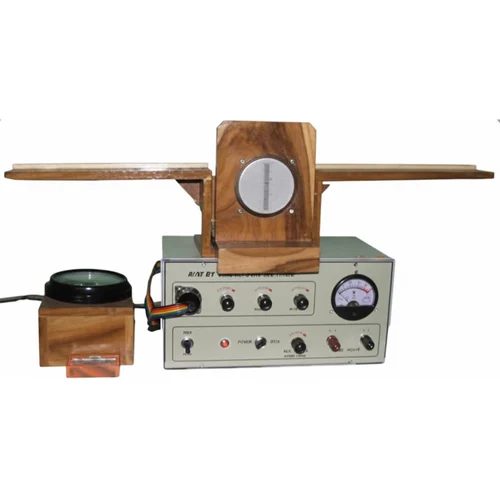
The Thomson Method Apparatus is a classic and highly effective laboratory instrument designed for performing the Thomson method experiment, which is used to determine the specific charge of an electron through the combined effects of electric and magnetic fields. Widely used in physics laboratories at universities, engineering colleges, and advanced teaching institutions, this apparatus plays a crucial role in helping students understand fundamental concepts related to electron motion, electromagnetic forces, and charged particle behavior. Operated using a standard 230 V power supply, the system integrates both electrical and magnetic control elements to create a stable and measurable experimental environment suitable for repeated academic use.
Description
The Thomson Method Apparatus is a classic physics laboratory instrument used to determine the charge-to-mass ratio (e/m) of an electron through controlled electric and magnetic deflection. At the core of the setup is a cathode ray tube mounted securely on a specially designed wooden stand. This insulated wooden structure provides mechanical stability, safe handling, and accurate alignment during experiments. Because clear visualization is essential, the apparatus allows students to observe electron beam deflection directly under controlled laboratory conditions.
Thomson Method Apparatus for Electron Beam Deflection Studies
The apparatus includes two adjustable wooden arms fitted with measurement scales. These arms hold the cathode ray tube centrally and allow precise measurement of the distance between magnetic poles. Therefore, students can accurately correlate theoretical calculations with experimental observations. A matched pair of bar magnets generates a uniform magnetic field perpendicular to the electric field, which forms the basis of the Thomson method by balancing electric and magnetic forces acting on the electron beam.
Power Supply, Controls, and Measurement Accuracy
A regulated power supply with an inbuilt voltmeter applies and measures the deflecting voltage across the electric field plates. Front-panel potentiometers provide fine control over beam focus, intensity, and horizontal and vertical positioning. As a result, students can obtain a sharp and stable electron beam for precise readings. X and Y shift controls further improve alignment without disturbing the physical setup. An eight-pin octal base mounted on the panel ensures secure cathode ray tube connection and minimizes setup errors during student use.
Compass Box and Educational Value
A compass box mounted on a separate wooden stand helps determine the direction and strength of the magnetic field accurately. This auxiliary stand can also be positioned centrally within the main arm structure for flexible experimentation. With an approximate weight of 4 kg, the apparatus balances sturdiness and portability. By enabling hands-on measurement of the electron charge-to-mass ratio, the Thomson Method Apparatus strengthens understanding of early atomic models, electromagnetic theory, and experimental physics techniques.
For complementary physics laboratory equipment, you may explore:
https://www.aseducationalkits.com/products-category/physics-lab-equipment/
For a wider range of laboratory and educational instruments, you can also refer to:
https://interlabs.in/products-catalogue/
Applications
Determination of electron charge-to-mass ratio
Study of electric and magnetic field interaction
Cathode ray and electron beam experiments
Undergraduate and postgraduate physics practicals
Demonstration of classical atomic physics concepts
See also different:
Hall Effect Setup

Orifice And Jet Velocity Apparatus
Orifice Discharge Apparatus

Laboratory Glass Tube