
The Solar Lunar Eclipse Model is an innovative and educationally rich demonstration tool designed to visually explain the intricate celestial mechanics behind solar and lunar eclipses. Crafted from durable PVC material and finished in a vibrant yellow color, this model is specially designed for institutional use, particularly for students in grades 9 to 12. It serves as a practical teaching aid that helps learners visualize and comprehend the astronomical phenomena of eclipses, rotation, and revolution in a hands-on and interactive manner. The model includes detailed representations of the Sun, Earth, and Moon, each strategically placed and proportionally aligned to simulate their real-world positioning and motion.
Description
The Solar Lunar Eclipse Model is a scientifically accurate teaching aid designed to explain the motion of the Sun, Earth, and Moon and the formation of eclipses through visual demonstration. It uses motorized rotation and revolution to show real celestial movement, while a built-in LED light represents the Sun. As a result, students can clearly understand how alignment and shadow formation create solar and lunar eclipses.
Schools and educational institutions across India commonly use this model in astronomy and earth science classes. Similarly, science educators in countries such as the United Kingdom, South Africa, and Kenya rely on eclipse models to simplify complex astronomical concepts for students.
Solar Lunar Eclipse Model for Understanding Eclipse Formation
The Solar Lunar Eclipse Model demonstrates how eclipses occur based on the relative positions of the Sun, Earth, and Moon. When the Moon moves between the Earth and the Sun, the model clearly shows a solar eclipse. Conversely, when the Earth moves between the Sun and the Moon, the model demonstrates a lunar eclipse by casting Earth’s shadow on the Moon.
Because the Sun includes an LED light source, students can observe shadow formation directly. Moreover, this illumination helps explain the difference between partial and total eclipses in a clear and engaging way.
Solar Lunar Eclipse Model for Rotation and Revolution Learning
The Solar Lunar Eclipse Model uses rotating motors to illustrate both rotation and revolution. Teachers use this motion-based setup to explain orbital paths, axial movement, and alignment principles. Therefore, students gain a deeper understanding of how celestial mechanics influence observable events in the sky.
Astronomy programs in countries such as Canada and Germany often use similar models to support inquiry-based learning. Consequently, learners connect textbook diagrams with realistic motion and light behavior.
Durable Design with LED Illumination
The model features strong PVC construction that supports frequent classroom use. Additionally, its lightweight and portable structure allows easy setup during lessons, labs, and science fairs. The LED light enhances visibility and adds realism to demonstrations, making concepts easier to remember.
Suitable for Classroom and Institutional Use
This model is suitable for school laboratories, science exhibitions, astronomy classes, and institutional demonstrations, especially for classes 9 to 12. It supports curriculum-aligned learning while encouraging curiosity and interactive observation.
Applications
- Demonstrating solar and lunar eclipses
- Teaching rotation and revolution of Earth and Moon
- Understanding shadow formation in astronomy
- Earth science and physics classroom demonstrations
- Science fairs and educational exhibitions
other educational working models and laboratory kits to enhance hands-on learning in engineering and technical laboratories. In addition, institutions may also explore complementary learning solutions such as Jaadui Pitara educational learning kits to support interactive and concept-based education.
See also different:
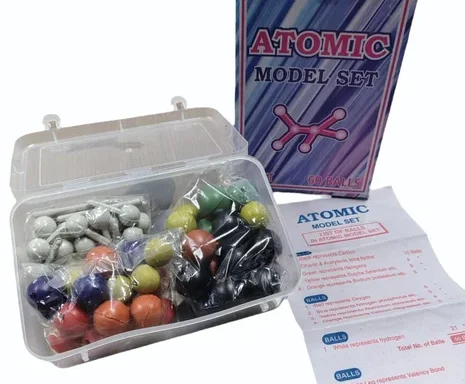
Atomic Model Set

Hydro Electric Generator Model

Electric Motor Demonstration Model

DC Motor Working Model