
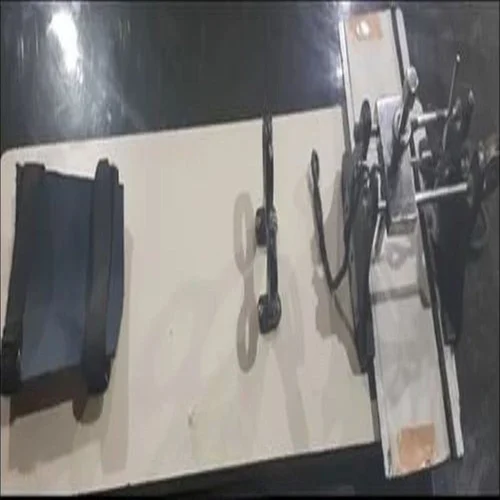
The psychology ergograph apparatus is a specialized instrument used to quantitatively assess muscular work capacity, endurance, and fatigue in humans. It was invented by the Italian physiologist Angelo Mosso in the early 1880s and was a key device in early psychology and physiology laboratories for objective study of physical and psychological factors in performance.
Description
A psychology ergograph apparatus is a specialized instrument used to measure muscular work capacity, endurance, and fatigue in humans. It helps quantify physical performance by recording repeated muscle contractions under controlled conditions. Because objective measurement is essential in psychological and physiological studies, this apparatus provides reliable data for analysis. Moreover, it allows students and researchers to understand how fatigue develops over time during sustained muscular activity. As a result, the psychology ergograph apparatus remains an important teaching and research tool in experimental psychology laboratories.
Psychology Ergograph Apparatus for Fatigue and Endurance Studies
In psychology and physiology laboratories, the psychology ergograph apparatus supports the study of muscle fatigue and work output. Test subjects perform repetitive movements while the apparatus records contraction strength and duration. Therefore, researchers can evaluate endurance levels and observe the decline in muscular performance. This controlled setup helps link physical output with psychological factors such as motivation, attention, and mental effort. Consequently, students gain clear insight into human performance under continuous workload conditions.
Historical Significance and Educational Value
The psychology ergograph apparatus was invented by the Italian physiologist Angelo Mosso in the early 1880s. He introduced this device to study the relationship between muscular fatigue and mental processes. Because of its historical importance, the apparatus holds a key place in early experimental psychology and physiology. Educational institutions still use it to demonstrate classic experiments and to teach quantitative methods in human performance analysis. Thus, it bridges theoretical concepts with hands-on experimentation.
Design, Measurement Accuracy, and Laboratory Use
The psychology ergograph apparatus features a mechanical recording system that tracks muscle contractions accurately. Its sturdy construction ensures consistent results during repeated experiments. In addition, the simple operating mechanism makes it suitable for student use in practical sessions. Because it delivers clear graphical output, learners can easily interpret performance trends and fatigue patterns. For related psychology and laboratory teaching equipment, you may explore:
https://www.aseducationalkits.com/products-category/physics-lab-equipment/
For a broader range of laboratory and educational instruments, professionals can also refer to:
https://interlabs.in/products-catalogue/
Applications
Assessment of muscular work capacity
Measurement of endurance and fatigue
Psychology and physiology practical experiments
Educational demonstrations of human performance
Research on physical and mental workload
See also different:
Uv Vis Spectrophotometer

Double Walled Vertical Autoclave

Decade Resistance Box
Psychological Test Equipments