
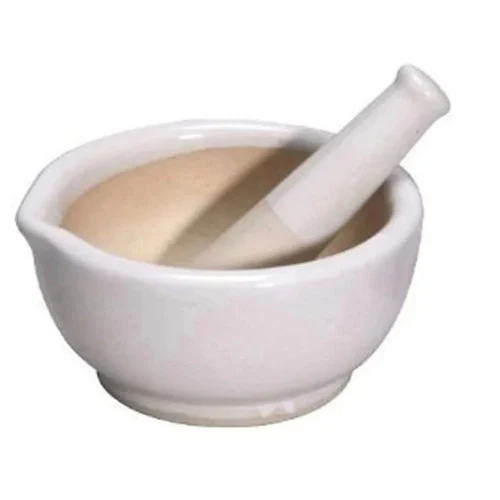
Porcelain mortars and pestles are versatile tools for grinding, crushing, and mixing solids into fine powders or pastes, essential in kitchens for spices (curry pastes, pesto, guacamole), pharmacies for compounding medicines (trituration), and labs for sample prep (chemicals, pigments, dental materials). Their non-porous, chemically resistant surface ensures purity, while the rough interior and pounding action release flavors better than blenders, preventing heat-induced oxidation and preserving potency.
Description
A porcelain pestle and mortar is a versatile tool used for grinding, crushing, and mixing solid materials into fine powders or smooth pastes. It is widely used in laboratories, pharmacies, kitchens, and educational institutions. Because porcelain has a non-porous and chemically resistant surface, it ensures sample purity during processing. Moreover, it does not absorb moisture, odors, or chemicals, which helps maintain consistency and accuracy. As a result, this tool supports reliable outcomes across scientific, pharmaceutical, and culinary applications.
Porcelain Pestle And Mortar for Laboratory and Pharmaceutical Applications
In laboratories and pharmacies, a porcelain pestle and mortar is essential for sample preparation and medicine compounding. Pharmacists use it for trituration, where controlled grinding improves uniformity and effectiveness of formulations. Therefore, it plays a key role in preparing powders, ointments, and experimental mixtures. In laboratory environments, researchers rely on it for crushing chemicals, pigments, and dental materials without risking contamination. Consequently, porcelain remains a preferred choice where chemical stability and precision matter.
Grinding Performance and Material Benefits
The rough interior surface of a porcelain pestle and mortar enhances grinding efficiency by providing effective friction and controlled pounding action. Unlike electric grinders or blenders, this manual method prevents excessive heat generation. As a result, sensitive compounds retain their chemical integrity and potency. In culinary use, this process releases natural oils and flavors from spices and herbs more effectively. Therefore, chefs prefer it for preparing curry pastes, pesto, and guacamole with superior aroma and texture.
Porcelain Pestle And Mortar in Education and Everyday Use
Educational institutions use a porcelain pestle and mortar to teach fundamental concepts of material processing and physical change. Students gain hands-on experience in grinding and mixing substances safely. In addition, its durable construction supports repeated use and easy cleaning. Because porcelain resists staining and corrosion, maintenance remains simple over time. For complementary laboratory equipment and teaching tools, users may explore:
https://www.aseducationalkits.com/products-category/physics-lab-equipment/
For a broader range of laboratory and scientific products, professionals can also refer to:
https://interlabs.in/products-catalogue/
Applications
Grinding and mixing laboratory chemicals
Pharmaceutical compounding and trituration
Preparation of spices and food pastes
Educational chemistry demonstrations
Processing pigments and dental materials
See also different:

Wall Mounted Thermometer

Laboratory Spirit Lamp

Reagent Bottle With Screw Cap

Student Projection Microscope for Classroom and Laboratory Demonstrations