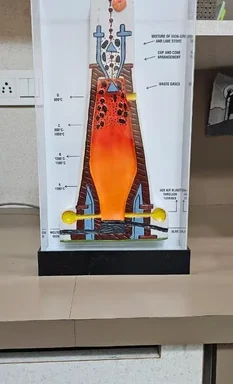
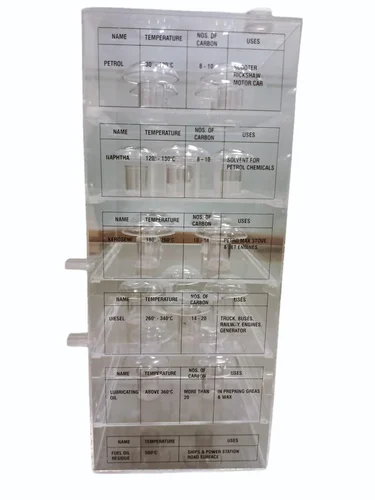
The Petroleum Purification Chemistry Model made of high-quality plastic is an essential educational tool designed to visually represent the process of purifying crude oil into its various useful components. With dimensions of 4 x 12 inches and a durable thickness of 2mm, this model provides a compact yet comprehensive depiction of the chemical and physical steps involved in petroleum purification. Engineered with clarity and precision, this plastic model serves as a vital resource for educators and students alike, particularly in academic settings that focus on chemistry, chemical engineering, and energy science.
Description
The Petroleum Purification Chemistry Model Plastic is an educational teaching aid designed to explain the process of petroleum purification through fractional distillation. This model visually demonstrates how crude oil is separated into different useful products based on their boiling points. Because petroleum refining is a complex industrial process, this model helps students understand each stage clearly through labeled diagrams and structured illustrations. Therefore, it is widely used in school laboratories, science classrooms, and STEM learning environments.
Understanding Fractional Distillation with Petroleum Purification Chemistry Model Plastic
The Petroleum Purification Chemistry Model Plastic clearly illustrates the structure of a fractional distillation column used in petroleum refineries. The model displays different stages within the column, showing how crude oil is heated and separated into various hydrocarbon fractions. Each fraction is collected at different heights in the column depending on its boiling point.
At the bottom of the column, heavier products such as bitumen and lubricating oil are shown. As the vapors rise upward, lighter fractions like diesel, kerosene, gasoline, and petroleum gases are separated at different levels. Consequently, students can easily understand how temperature gradients within the column allow different components of crude oil to be collected separately.
Educational Importance in Chemistry Learning
The Petroleum Purification Chemistry Model Plastic helps simplify complicated industrial chemical processes into a visual and interactive format. Students often find it difficult to understand refinery operations through textbooks alone. However, this model presents the information through diagrams and labeled sections, which improves comprehension and retention.
Teachers can use the model to explain topics such as hydrocarbon separation, boiling point differences, and petroleum refining techniques. As a result, students gain a clearer understanding of how raw crude oil is transformed into fuels and other useful products used in everyday life.
Durable Construction for Classroom and Laboratory Use
The Petroleum Purification Chemistry Model Plastic is made from high-quality plastic that ensures durability and long-term use in educational settings. Because classroom models are frequently handled during demonstrations and experiments, the sturdy material helps maintain the model’s structure and appearance over time.
Its lightweight construction allows easy transportation and placement on laboratory benches or classroom display boards. Moreover, the plastic surface is easy to clean and maintain, ensuring the model remains visually clear and presentable for repeated demonstrations.
Applications in Science Education and Training
The Petroleum Purification Chemistry Model Plastic is commonly used in secondary schools, colleges, and vocational training institutes that teach industrial chemistry or petroleum processing. Educators use the model to demonstrate the working principles of refineries and the role of distillation in chemical engineering.
Additionally, it is suitable for science exhibitions, classroom demonstrations, and STEM education programs. Students can observe the step-by-step separation process, which encourages interactive learning and scientific curiosity.
Promoting Awareness of Energy and Industrial Processes
The Petroleum Purification Chemistry Model Plastic also helps students understand the importance of petroleum refining in modern industries. By observing how crude oil is converted into fuels and other useful products, learners gain insight into the global energy supply chain.
Furthermore, discussions using this model can include topics such as energy production, environmental impact, and sustainable resource management. Consequently, students become more aware of the scientific and industrial processes behind everyday energy sources.
Role in Interactive STEM Learning
The Petroleum Purification Chemistry Model Plastic bridges the gap between theoretical chemistry and real-world industrial processes. By providing a detailed visual representation of fractional distillation, it enhances student engagement and improves conceptual understanding.
Its combination of clear diagrams, durable construction, and educational relevance makes it an important teaching tool for chemistry education. Therefore, this model remains a valuable addition to laboratories and classrooms focused on effective science learning.
For related laboratory and educational equipment, you may explore:
https://www.aseducationalkits.com/products-category/physics-lab-equipment/
For a broader range of laboratory and analytical solutions, professionals can also refer to:
https://interlabs.in/products-catalogue/