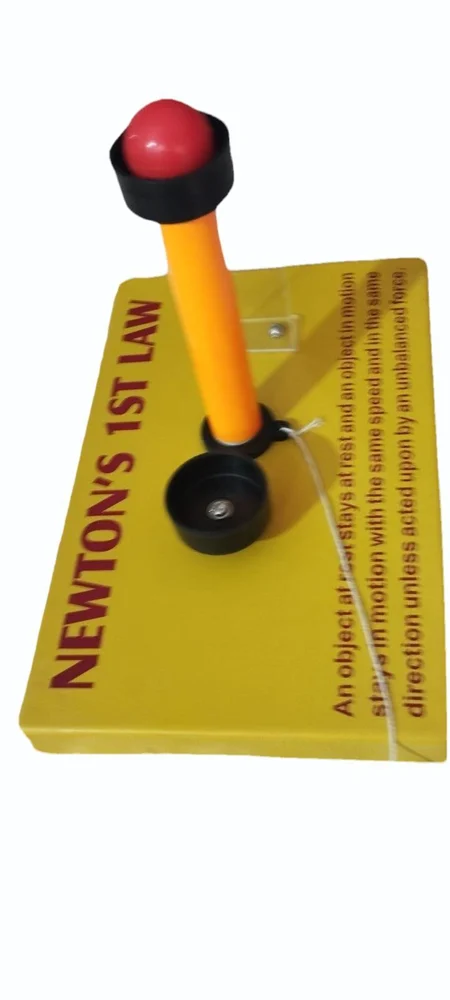
The Newton’s First Law Model is a meticulously designed educational apparatus crafted from durable stainless steel, intended to visually and practically demonstrate one of the fundamental principles of classical physics—Newton’s First Law of Motion. Also known as the Law of Inertia, this principle states that an object at rest stays at rest, and an object in motion continues in motion with the same speed and in the same direction unless acted upon by an unbalanced external force. This model is ideal for students in classes 9 through 12, offering a hands-on, engaging method for understanding a concept that underpins much of mechanical physics.
Made entirely from premium stainless steel, the model is built to withstand frequent classroom handling, ensuring long-term durability and safety during demonstrations. The polished surface and robust framework reflect a professional-grade build, which not only makes the model aesthetically appealing but also resistant to corrosion, wear, and damage. Stainless steel provides the strength and stability necessary to conduct accurate and repeatable experiments, making this model suitable for continuous use in both school laboratories and science exhibition settings.
Description
The Newton’s First Law Model allows educators to illustrate how an object will maintain its current state—either at rest or in uniform motion—unless disturbed by an external force. This demonstration is particularly effective in helping students understand the practical implications of inertia, force, and motion. The setup typically includes a base, a track, and a movable object (such as a ball or slider) that can be used to demonstrate motion in a straight line. By removing friction or minimizing it through smooth surfaces and balanced design, students are able to observe nearly ideal inertial behavior, reinforcing their theoretical understanding with real-world visualization.
Recommended specifically for physics learning and science projects, this model aligns seamlessly with school curriculums and examination boards. It supports interactive learning and conceptual clarity by offering students a tangible way to experience Newton’s laws, rather than relying solely on textbook explanations. As students manipulate the components, they can observe how motion is sustained until a force—such as friction, impact, or resistance—is introduced, thereby altering the object’s velocity or direction. Such real-time experimentation fosters critical thinking, curiosity, and a deeper grasp of physics principles.
The Newton’s First Law Model is not just a classroom tool but also an excellent resource for science fairs, laboratory assessments, and physics workshops. Its compact yet effective design makes it easy to set up and operate, requiring minimal maintenance while delivering consistent performance. The sturdy stainless steel construction ensures that the model retains its form and function across numerous demonstrations, making it a valuable addition to any physics teaching lab.
In summary, the Newton’s First Law Model made from stainless steel is a high-quality, curriculum-aligned educational resource for classes 9 to 12. It brings theoretical physics to life through practical demonstration, enabling students to witness firsthand the behavior of objects in rest and motion as described by Newton’s First Law. Ideal for academic institutions, this model fosters a deeper understanding of inertia, motion, and force while promoting interactive and experiential learning in physics education.