
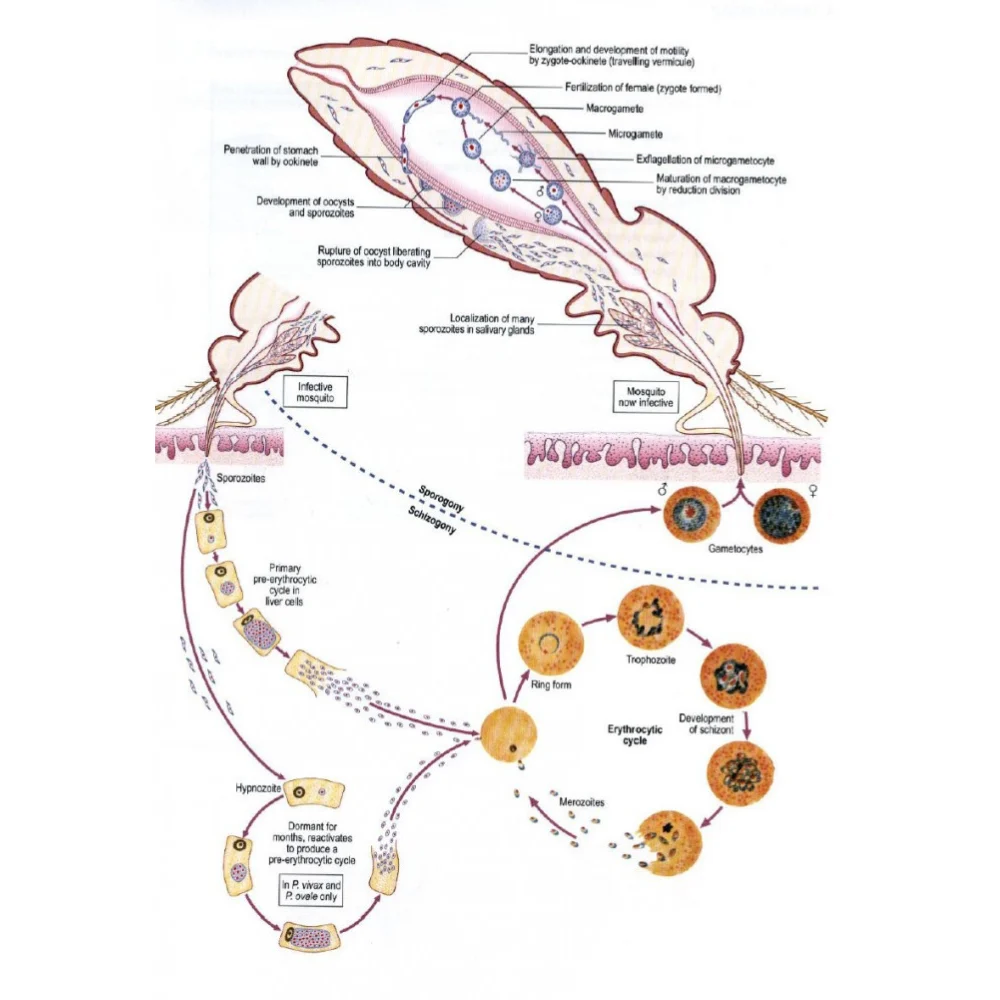
The Fiberglass Malaria Parasite Model Life Cycle is a meticulously crafted educational tool designed to provide a comprehensive and visual representation of the life cycle of the Plasmodium parasite, the causative agent of malaria. This model is made from high-quality fiberglass material, offering exceptional durability, resistance to wear and tear, and a detailed finish that captures the intricate stages of the parasite’s development. Its robust construction makes it suitable for consistent use in laboratories, medical colleges, and hospitals where accurate and long-lasting instructional materials are essential.
Description
Malaria Parasite Biology Lab Model for Life Cycle Understanding
The Malaria Parasite Biology Lab Model helps students understand the complete malaria life cycle through clear visual representation. The model measures 18 × 24 inches, which provides excellent visibility during lectures and examinations. A heavy wooden base keeps the model stable on laboratory benches, walls, or display stands. Natural colors replicate biological structures accurately and improve student engagement during learning sessions.
Malaria Parasite Biology Lab Model for Medical and Clinical Training
This model supports advanced learning in medical colleges and healthcare training institutes. It illustrates each stage of parasite development, starting with transmission by the Anopheles mosquito. Students can then follow parasite growth inside the human host and its return to the mosquito vector. Therefore, learners gain a complete understanding of malaria transmission, disease progression, and epidemiology. Educators often use this model to explain complex concepts in microbiology and parasitology clearly.
Encourages Visual and Practical Learning
The three-dimensional layout allows students to examine each stage closely. Clear labels guide learners through the parasite’s progression step by step. As a result, students connect theoretical knowledge with real biological processes. The model also supports learning in pathology, infectious diseases, and tropical medicine courses.
Strong Construction for Academic Use
The model uses durable materials and weighs approximately 10 kg, which ensures stability during demonstrations. Secure packaging protects the model during storage and transport. Its solid build supports repeated use in busy laboratories and teaching environments without damage.
Supports Public Health Education
The Malaria Parasite Biology Lab Model also helps instructors explain malaria prevention and control strategies. Trainers use it in public health workshops to show how the parasite spreads between humans and mosquitoes. These demonstrations strengthen awareness of timely diagnosis and treatment.
This product is intended strictly for education and demonstration use only and not for clinical diagnosis or medical decision-making. Overall, the Malaria Parasite Biology Lab Model provides a clear, durable, and effective tool for teaching parasitology and tropical disease concepts.
other educational working models and laboratory kits to enhance hands-on learning in engineering and technical laboratories. In addition, institutions may also explore complementary learning solutions such as Jaadui Pitara educational learning kits to support interactive and concept-based education.