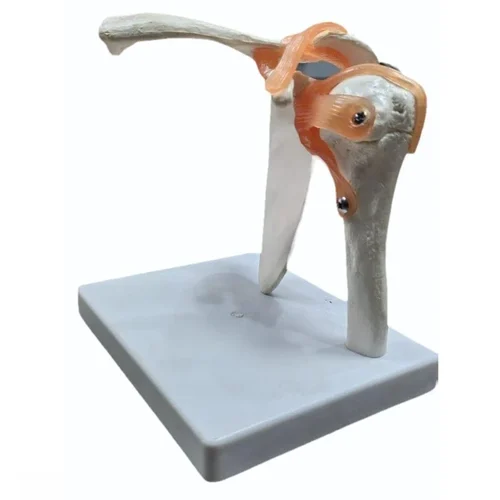
The PVC human joints model is an essential piece of educational equipment designed to provide a clear and accurate representation of the human skeletal joint system. Constructed from durable and high-quality PVC material, this model is built to withstand frequent handling, making it ideal for use in classrooms, laboratories, and training environments where hands-on learning is a priority. Its realistic design allows students, teachers, and medical professionals to explore the structure, movement, and function of different human joints in detail, enhancing both theoretical and practical understanding of human anatomy. The model is lightweight, easy to handle, and designed to replicate the natural articulation of joints, making it an invaluable resource for teaching anatomy, physiology, biomechanics, and medical sciences.
Description
This educational tool is particularly useful for demonstrating the types of joints found in the human body, including ball-and-socket joints, hinge joints, pivot joints, and more. Each joint is carefully designed to simulate natural movement, allowing learners to observe how bones connect and interact during different motions. The PVC human joints model not only provides an accurate visual representation but also enables tactile exploration, which is critical for developing a deeper understanding of anatomical functions. The high-quality PVC construction ensures that the joints retain their shape and functionality even after prolonged use, offering long-term durability and reliability for continuous educational purposes.
In academic settings, the PVC human joints model serves as a practical teaching aid for students in medical colleges, nursing schools, physiotherapy programs, and biology classes. By providing a three-dimensional representation of the joints, it makes it easier for learners to comprehend complex anatomical concepts that may be difficult to grasp through textbooks or two-dimensional images alone. This model is particularly effective in demonstrating the range of motion, joint stability, and the impact of different physical forces on the skeletal system. As a result, students can relate theoretical knowledge to practical application, thereby enhancing their learning outcomes and retention of information.
The model is also highly valuable for training in fields such as physiotherapy, sports medicine, and orthopedics. Professionals in these areas can use the PVC human joints model to explain injuries, treatments, and exercises to patients in a clear and visual way. This makes it not only an educational resource for students but also a communication tool for practitioners working with patients who may benefit from a better understanding of their joint conditions. Its realistic structure and movements allow for demonstrations of common joint problems, therapies, and rehabilitation techniques, making it versatile across both academic and clinical settings.
With its durable design and accurate anatomical detail, the PVC human joints model is a cost-effective and long-lasting addition to any educational institution or training facility. It is lightweight for easy transport and storage, while still being robust enough to endure regular use in busy learning environments. By combining durability, realism, and functionality, this model provides a comprehensive learning experience that supports skill development and knowledge acquisition. Whether used for classroom demonstrations, laboratory experiments, or professional training, the PVC human joints model is a reliable and effective educational tool that helps learners develop a strong foundation in human anatomy and joint mechanics.