

The DC Motor Working Model is a comprehensive educational tool designed to effectively demonstrate the core principles of electromagnetism and rotational motion in physics. Built using durable fiber material, this model is a perfect hands-on learning aid for students, educators, and science enthusiasts seeking to understand the operational mechanism of a direct current (DC) motor. With a working voltage range of 6 to 12 volts and an input current of 3 amps, the model delivers safe, efficient, and reliable functionality, making it ideal for classroom demonstrations, physics lab experiments, and individual science projects.
This DC motor working model is specifically tailored to meet the academic requirements of physics as a subject, offering a tangible representation of how electrical energy is converted into mechanical energy. The model is crafted with precision to allow easy visualization of its internal components and functioning parts. Whether it’s the commutator, rotor, brushes, or coil, each part is clearly visible and accessible, enabling learners to better understand the sequence of energy transformations and the role of magnetic fields in creating motion.
Description
The DC Motor Working Model is a practical and interactive teaching aid designed to demonstrate the construction and working of a direct current motor. It operates on a 12V DC power supply and can also function safely at lower voltages such as 6V. As a result, students can perform experiments with flexibility while maintaining safety during classroom and laboratory use.
Schools, colleges, and technical institutes across India commonly use this model for physics and basic engineering demonstrations. Similarly, educational institutions in countries such as the United Kingdom, South Africa, and Kenya rely on DC motor models to explain core concepts of electromagnetism and mechanical motion.
DC Motor Working Model for Understanding Motor Operation
The DC Motor Working Model clearly shows how electrical energy converts into mechanical energy through rotational motion. When current flows through the coil, it creates a magnetic field that interacts with the permanent magnet. Therefore, the motor shaft begins to rotate, allowing students to observe real-time motor operation.
The model includes clear polarity markings, which help learners explore how reversing current direction changes the direction of rotation. Moreover, this feature supports practical understanding of current flow and magnetic interaction.
DC Motor Working Model for Electromagnetism Concepts
The DC Motor Working Model helps explain key physics principles such as Fleming’s Left-Hand Rule, torque generation, and electromagnetic force. Teachers often use it to demonstrate how magnetic fields and electric currents interact to produce motion. Consequently, students can relate theoretical diagrams directly to a working system.
Because the model supports an input current of up to 3 amps, it delivers smooth and observable rotation without overheating. Additionally, it works well with battery packs and laboratory DC power supplies, which makes it suitable for multiple learning environments.
Durable Fiber Construction and DIY Assembly
The model uses fiber material, which offers a lightweight yet durable structure. As a result, it withstands repeated use in labs, workshops, and science exhibitions. The kit-based design encourages students to assemble and disassemble the motor, helping them understand each component’s role and placement.
Suitable for Practical Learning and Demonstrations
This DC motor working model suits actual demonstrations, classroom teaching, lab experiments, science fairs, and introductory engineering learning. It supports inquiry-based learning while strengthening problem-solving and analytical skills.
Applications
- Demonstrating DC motor construction and working
- Teaching electromagnetism and Fleming’s Left-Hand Rule
- Exploring direction of rotation and polarity effects
- Physics lab experiments and science exhibitions
- Introductory electronics and engineering education
other educational working models and laboratory kits to enhance hands-on learning in engineering and technical laboratories. In addition, institutions may also explore complementary learning solutions such as Jaadui Pitara educational learning kits to support interactive and concept-based education.
See also different:
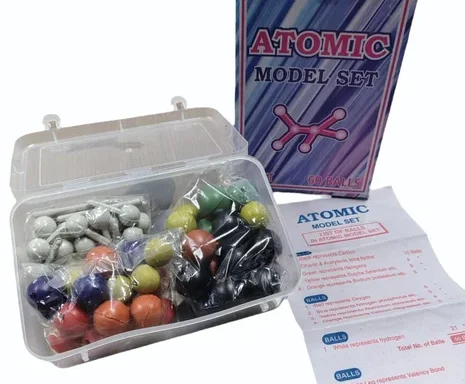
Atomic Model Set

Hydro Electric Generator Model

Electric Motor Demonstration Model

Solar Lunar Eclipse Model