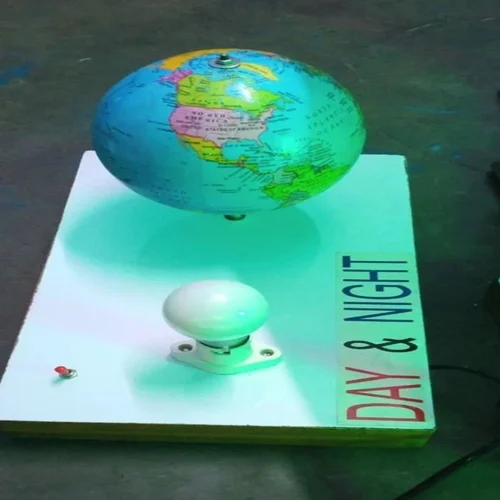
A Day and Night Apparatus is a science model used primarily in education to visually demonstrate how Earth’s rotation on its axis causes day and night, showing how different parts face the sun (day) or are in shadow (night) over 24 hours, helping explain time zones, sunrise/sunset patterns, and basic astronomy. It typically features a globe, a light source (Sun), and sometimes an tilted axis to illustrate seasonal effects on day length.
Description
The Day and Night Apparatus is an educational science model designed to clearly demonstrate how Earth’s rotation on its axis causes the cycle of day and night. By visually showing how different parts of the Earth face the Sun or move into shadow, this apparatus helps students understand a fundamental concept of astronomy in a simple and engaging way. As a result, learners can connect textbook theory with real-world observation.
Schools across India commonly use this apparatus in geography and science classrooms. In addition, educational institutions in countries such as the United Kingdom, South Africa, and Kenya rely on day and night models to explain basic Earth–Sun relationships effectively.
Day and Night Apparatus for Understanding Earth’s Rotation
The Day and Night Apparatus uses a globe to represent Earth and a light source to represent the Sun. When the globe rotates, students can observe how one side receives sunlight while the opposite side remains in darkness. Therefore, the concept of day and night becomes visually clear and easy to grasp.
Because the model shows a full 24-hour rotation cycle, teachers can explain how sunrise and sunset occur at different times across the globe. Moreover, students learn why it is daytime in one region while another experiences night at the same moment.
Day and Night Apparatus for Time Zones and Astronomy Learning
The Day and Night Apparatus also helps explain time zones and global time differences. Educators use it to show how Earth’s rotation leads to varying local times across longitudes. Consequently, students gain a foundational understanding of world time zones and international time differences.
Some models include a tilted axis, which allows teachers to introduce seasonal variations in daylight length. As a result, learners can begin to understand why days are longer or shorter at different times of the year.
Simple Design and Classroom-Friendly Construction
The apparatus features a sturdy, easy-to-handle design suitable for repeated classroom use. Additionally, its clear visual layout allows students to observe concepts from multiple angles during group demonstrations. The lightweight structure makes it easy to move between classrooms or laboratories.
Suitable for Educational Demonstration Use
This day and night apparatus is suitable for school classrooms, science laboratories, geography lessons, astronomy demonstrations, and science exhibitions. It supports curriculum-aligned teaching for upper primary and secondary levels.
Applications
- Demonstrating the day and night cycle
- Teaching Earth’s rotation and basic astronomy
- Explaining sunrise and sunset patterns
- Understanding time zones and global time differences
- Classroom demonstrations and science exhibitions
other educational working models and laboratory kits to enhance hands-on learning in engineering and technical laboratories. In addition, institutions may also explore complementary learning solutions such as Jaadui Pitara educational learning kits to support interactive and concept-based education.