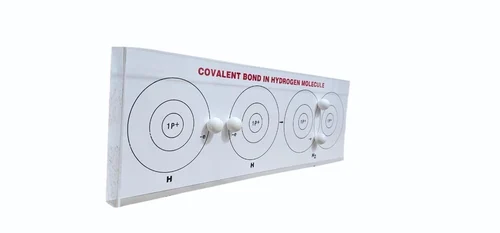
The Covalent Bond Hydrogen Molecule Model is a meticulously designed educational tool crafted to illustrate the concept of covalent bonding using a simple and visually engaging representation of the hydrogen molecule (H₂). Made from durable, high-quality plastic, this working model is engineered for interactive learning, making it a perfect fit for school-level science education. With dimensions of 4 x 10 inches and a sleek white finish, the model offers an easy-to-understand and accurate depiction of how two hydrogen atoms share electrons to form a stable covalent bond, a foundational concept in chemistry that is crucial for students to grasp at an early academic stage.
Description
The Covalent Bond Hydrogen Molecule Model is an educational teaching aid designed to help students clearly understand the concept of covalent bonding and molecular formation. It demonstrates how two hydrogen atoms share electrons to form a stable hydrogen molecule (H₂). Therefore, the model provides a visual and interactive method for explaining atomic interactions that are often difficult to grasp through textbook diagrams alone.
Educational Purpose of the Covalent Bond Hydrogen Molecule Model
The Covalent Bond Hydrogen Molecule Model allows learners to observe how electron sharing leads to the formation of a covalent bond. Because hydrogen forms the simplest diatomic molecule, it becomes an ideal starting point for introducing fundamental chemical bonding concepts. Teachers can use the model to explain how atoms achieve stability by sharing electrons rather than transferring them.
In addition, the model helps students understand key chemistry topics such as molecular symmetry, atomic configuration, and bonding principles. As a result, learners gain a clearer understanding of how simple molecular structures form the basis of more complex organic and inorganic compounds.
Interactive Learning and Classroom Demonstration
The Covalent Bond Hydrogen Molecule Model provides a hands-on learning experience that enhances classroom interaction. The adjustable working components allow educators to demonstrate atomic bonding processes step by step. Consequently, students can physically observe how two hydrogen atoms combine to form a molecule.
This interactive approach encourages inquiry-based learning. Visual and kinesthetic learners benefit greatly from this method because they can directly see and manipulate the structural representation of a molecule. Therefore, the model becomes a powerful tool for strengthening conceptual understanding.
Durable Construction and Practical Design
The Covalent Bond Hydrogen Molecule Model is manufactured using durable white plastic that is lightweight, chemically inert, and resistant to wear. This construction ensures the model remains in good condition even after frequent classroom use. Moreover, the smooth white finish provides a clean scientific appearance that keeps the focus on structural details rather than decorative elements.
With approximate dimensions of 4 × 10 inches, the model is large enough to be clearly visible during classroom demonstrations. At the same time, it remains compact enough for desk-based study, group activities, or laboratory demonstrations.
Applications in Science Education and Demonstrations
The Covalent Bond Hydrogen Molecule Model is widely used in school laboratories, science classrooms, and educational workshops. It supports chemistry lessons for middle and high school students, especially those studying atomic theory and molecular bonding. In addition, students often use the model for science exhibitions, academic presentations, and practical demonstrations.
Because the model clearly represents covalent bonding in hydrogen molecules, it helps build the foundation for understanding more complex molecular structures. Consequently, students develop stronger analytical skills when studying chemical reactions and molecular interactions.
Importance in STEM Learning
The Covalent Bond Hydrogen Molecule Model bridges the gap between theoretical chemistry concepts and practical visualization. By transforming abstract bonding theories into a physical representation, it improves comprehension and knowledge retention. As a result, teachers can explain atomic interaction and molecular formation more effectively.
This model not only supports curriculum-based learning but also inspires curiosity about molecular chemistry and scientific exploration. Therefore, it remains an essential educational resource for institutions focused on strengthening STEM education.
For related laboratory and educational equipment, you may explore:
https://www.aseducationalkits.com/products-category/physics-lab-equipment/
For a broader range of laboratory and analytical solutions, professionals can also refer to:
https://interlabs.in/products-catalogue/