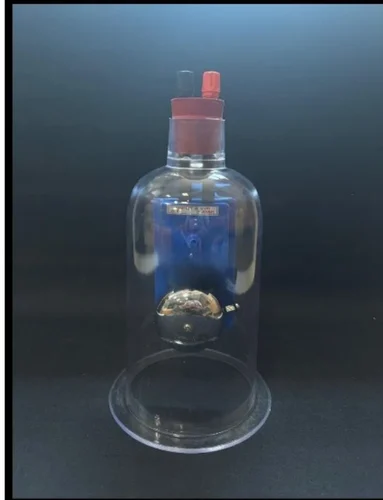
A “bell in a bell jar” is primarily an educational apparatus demonstrating that sound needs a medium (like air) to travel; by ringing a bell inside a sealed jar and pumping the air out, the sound fades because there are no air particles for the sound waves to vibrate through, proving sound can’t travel in a vacuum, with related uses including vacuum experiments for air resistance and chemistry.
Description
Bell in Bell Jar – Demonstration of Sound in Vacuum
The Bell in Bell Jar is a classic laboratory apparatus used to demonstrate that sound requires a medium to travel. This educational setup includes a bell placed inside a sealed glass jar. When the bell rings, students can clearly hear the sound while air is present inside the jar.
However, as air is gradually removed using a vacuum pump, the sound becomes faint and eventually disappears. This happens because sound waves need air particles to travel. Without a medium, sound cannot propagate. Therefore, this experiment clearly proves that sound cannot travel in a vacuum.
Concept
The Bell in Bell Jar experiment focuses on the basic principle of sound transmission. Sound travels through vibrations that move across particles in a medium such as air.
When the air is removed from the jar, fewer particles remain to carry these vibrations. As a result, the sound intensity decreases. This simple observation helps students understand the relationship between sound and medium.
Learning
This experiment helps students understand important scientific concepts such as sound waves, vibration, and vacuum conditions. It also demonstrates how the absence of a medium affects sound transmission.
Students can visually and audibly observe the change in sound intensity. Because of this, the experiment improves conceptual clarity and encourages curiosity in physics learning.
Applications in STEM Education
Teachers use the Bell in Bell Jar in classrooms, laboratories, and science demonstrations. It provides a clear and practical way to explain sound propagation and vacuum principles.
The setup also supports experiments related to air pressure and air resistance. Therefore, it becomes a versatile tool for both physics and chemistry learning.
For more innovative educational science kits and learning tools, explore:
https://www.aseducationalkits.com/products-showcase/
Additionally, laboratories and institutions looking for high-quality scientific equipment can visit:
https://www.iwaki-pyrex.com/products/
Real-World Relevance
The Bell in Bell Jar model helps students understand why sound does not travel in space. It also explains how sound behaves differently in various environments.
Because of its practical demonstration, the experiment builds a strong foundation in acoustics and wave physics. As a result, students gain both theoretical knowledge and real-world understanding.