
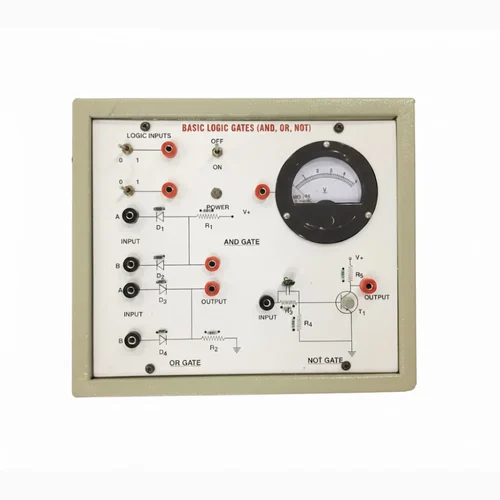
The Basic Logic Gates using Discrete Components apparatus is an essential educational equipment designed to introduce students to the fundamental building blocks of digital electronics through hands-on experimentation and observation. Commonly used in electronics laboratories at engineering colleges, polytechnic institutes, and technical training centers, this trainer enables learners to study the operation of five basic logic gates constructed using individual discrete electronic components rather than integrated circuits. This approach allows students to develop a deeper understanding of how logic functions are physically realized at the component level, bridging the gap between abstract Boolean logic theory and real-world electronic implementation. By assembling and analyzing circuits composed of resistors, diodes, transistors, and other basic elements, students gain valuable insight into signal behavior, switching action, voltage levels, and current flow that form the foundation of digital systems.
Description
The apparatus provides a clear and structured platform for experimenting with fundamental logic operations such as AND, OR, NOT, NAND, and NOR, enabling learners to verify truth tables and logical expressions through practical observation. Input combinations can be applied systematically, allowing students to observe corresponding output states and understand the logical relationships governing each gate. This hands-on interaction reinforces theoretical concepts taught in digital electronics courses and helps students build confidence in circuit analysis and logical reasoning. The use of discrete components makes the internal functioning of each logic gate visible and understandable, which is particularly beneficial for beginners who are transitioning from basic electronics to more advanced digital system studies.
Designed specifically for laboratory applications, the trainer is built to withstand regular handling and repeated experimentation in academic environments. The layout of the circuitry is organized and accessible, allowing students to easily identify individual components and trace signal paths without confusion. This clarity supports effective troubleshooting exercises, where learners can intentionally introduce faults or modify connections to observe their impact on circuit behavior. Such practical exposure enhances problem-solving skills and fosters a deeper appreciation of circuit reliability and design considerations in digital electronics.
The Basic Logic Gates using Discrete Components apparatus is especially valuable in reinforcing core topics such as binary logic, voltage level interpretation, noise margins, and switching characteristics. By working with discrete components, students can directly observe the effects of component tolerances and real-world non-idealities that are often hidden when using integrated logic devices. This experiential learning approach strengthens conceptual understanding and prepares learners for advanced subjects such as combinational logic design, sequential circuits, microprocessors, and embedded systems. The trainer also serves as a strong foundation for understanding how complex digital integrated circuits are constructed from simple logic building blocks.
Overall, this educational trainer plays a vital role in digital electronics laboratories by promoting active learning and conceptual clarity. It supports outcome-based education by encouraging experimentation, verification of theoretical principles, and independent analysis. Suitable for a wide range of academic programs, the Basic Logic Gates using Discrete Components apparatus helps students develop a solid and lasting understanding of digital logic fundamentals, making it an indispensable teaching and learning tool in electronics education.
See also different:
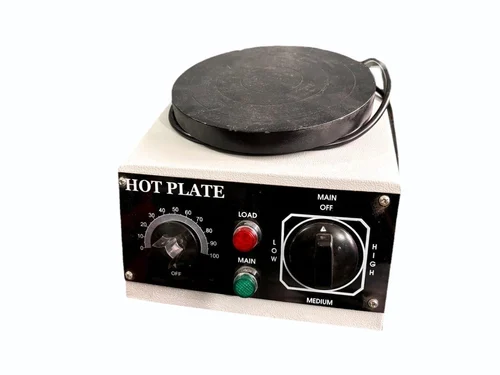
Hot Plate Magnetic Stirrer

Induction Coil (Ruhmkorff Coil )

Wooden Brown Cube

Racer Digital Stopwatch