
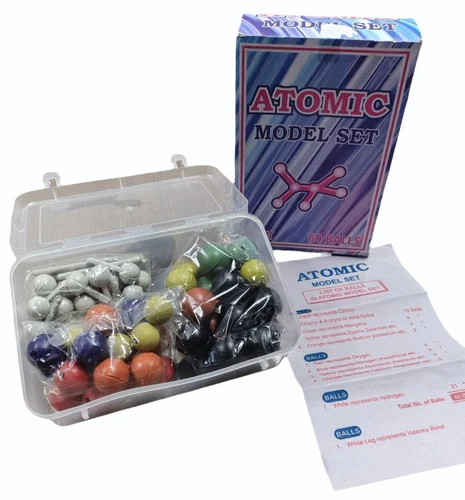
The Plastic Atomic Model Set is a comprehensive and visually engaging educational tool designed to facilitate a deeper understanding of atomic structure and chemical bonding for students in classes 9 to 12. Made entirely from durable plastic, this non-working model set serves as an essential classroom aid for the subject of physics, particularly in the topics of atomic theory, molecular structure, and valency. With its vivid color-coded components and well-thought-out design, the set provides students with a hands-on, interactive experience that bridges the gap between theoretical chemistry concepts and real-world atomic representation.
Description
The Atomic Model Set is an interactive educational tool designed to help students understand atomic structure, chemical bonding, and molecular formation through hands-on learning. The set contains 60 high-quality plastic balls, each color representing a specific element or group of elements. As a result, learners can easily identify atoms and understand how different elements behave when forming molecules.
Schools and colleges across India widely use atomic model sets in chemistry laboratories. Likewise, educational institutions in countries such as the United Kingdom, South Africa, and Kenya rely on these models to simplify abstract chemical concepts for students.
Atomic Model Set for Understanding Atoms and Elements
The Atomic Model Set uses a clear color-coding system to represent various elements. Black balls represent carbon atoms, which students use to build ethanic, acetylenic, and other hydrocarbon structures. Green balls represent halogen elements, allowing learners to model compounds containing chlorine, fluorine, or bromine.
Red balls depict oxygen atoms, which play a key role in water, oxides, and biological molecules. Blue balls represent nitrogen and phosphorus, making it easier to construct ammonia, phosphates, and basic biomolecular structures. White balls represent hydrogen atoms, which help students understand acids, bases, and hydrocarbon bonding.
Atomic Model Set for Bonding and Molecular Structure Learning
The Atomic Model Set also includes white plastic connectors that act as valence bonds. These connectors allow students to form single, double, and triple bonds according to atomic valency. Therefore, learners can clearly visualize covalent bonding, ionic bonding, and molecular geometry.
Orange balls represent alkali metals such as sodium and potassium, as well as alkaline earth metals like calcium and magnesium. This feature enables students to model salts and ionic compounds effectively. In addition, yellow balls represent sulfur, selenium, aluminium, and chromium, which helps demonstrate functional groups, metallic bonding, and transition element behavior.
Durable Design and Classroom-Friendly Use
The model components use durable plastic that withstands repeated classroom use. Moreover, the lightweight design allows easy transport and storage. Teachers can conduct demonstrations efficiently, while students can work independently or in groups during practical sessions.
Suitable for Classroom and Home Learning
This atomic model set is suitable for school laboratories, college chemistry classes, science fairs, and home learning environments. It supports both introductory and advanced chemistry topics, helping learners build a strong foundation in atomic theory and molecular chemistry.
Applications
- Teaching atomic structure and elements
- Demonstrating covalent and ionic bonding
- Molecular geometry and hybridization learning
- Chemistry lab demonstrations and science fairs
- Practical learning for secondary and higher education
other educational working models and laboratory kits to enhance hands-on learning in engineering and technical laboratories. In addition, institutions may also explore complementary learning solutions such as Jaadui Pitara educational learning kits to support interactive and concept-based education.
See also different:

Hydro Electric Generator Model

Electric Motor Demonstration Model

Solar Lunar Eclipse Model

DC Motor Working Model