
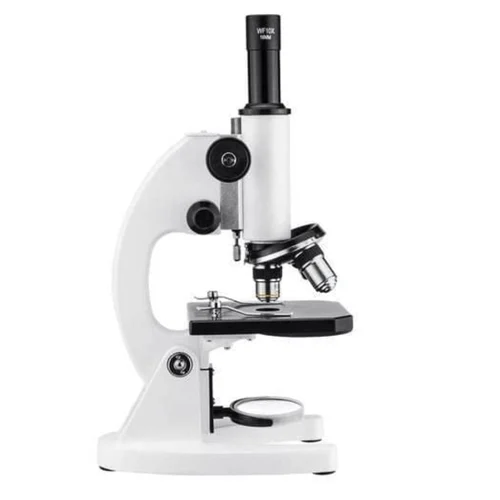
A student compound microscope is one of the most fundamental and essential pieces of educational equipment used in schools, colleges, and research institutions to study the microscopic world in detail. Designed with precision optics and advanced magnification capabilities, it allows students and researchers to explore the structure of cells, tissues, and microorganisms that cannot be observed with the naked eye. By combining multiple lenses to achieve high levels of magnification and clarity, the compound microscope transforms scientific learning into a hands-on experience, bridging the gap between theoretical concepts and practical observation. Its ability to reveal intricate details makes it indispensable for studies in biology, life sciences, medical education, and material sciences, providing learners with the opportunity to deepen their understanding of microscopic structures and biological processes.
Description
The student compound microscope works by using an objective lens close to the specimen and an eyepiece lens that magnifies the image formed by the objective. This system of lenses produces a highly detailed and enlarged view of the sample, allowing students to study cellular structures, bacteria, plant tissues, and other specimens with precision. Most educational compound microscopes come equipped with multiple objective lenses of varying magnifications, usually ranging from low power to high power, enabling users to switch between magnifications based on the level of detail required. The addition of a fine and coarse focusing mechanism ensures that students can adjust the sharpness of the image, learning how to work with optical instruments effectively.
Illumination plays a critical role in the performance of a compound microscope, and modern designs often incorporate built-in LED or mirror-based light sources that provide consistent brightness. This ensures that even the most transparent specimens can be clearly observed. Some advanced versions also include adjustable diaphragms and condensers that allow control of light intensity and contrast, giving learners the ability to observe specimens with enhanced clarity. These features not only make the microscope suitable for academic labs but also for higher-level research training, ensuring versatility in its use.
Durability and reliability are key aspects of a compound microscope intended for educational use. Constructed with a sturdy body and high-quality optical glass lenses, it is designed to withstand frequent handling by students while maintaining precision over long-term use. The ergonomic design with a stable base ensures ease of use during extended observation sessions, making it comfortable for learners to engage in laboratory experiments. Its compact size also makes it easy to integrate into classroom environments without occupying excessive space, while still offering powerful magnification and clear visualization.
The educational value of a student compound microscope extends beyond biology classrooms. It is widely used in environmental science, forensic studies, material analysis, and medical training. Students gain hands-on experience in preparing slides, focusing the lenses, and analyzing minute details, which enhances their practical learning and strengthens their understanding of scientific methods. In research institutions and advanced laboratories, the compound microscope continues to serve as a foundational tool for examining structures at the cellular level, playing a vital role in discoveries and innovations.
Overall, the student compound microscope is an indispensable educational instrument that provides unmatched clarity, magnification, and usability. By allowing learners to explore the hidden world of microscopic structures, it not only enriches classroom teaching but also inspires curiosity, scientific thinking, and a deeper appreciation of the natural world.
See also different:

Science Working Models

0.01mm Brass Outside Micrometer

Bicycle Dynamo Set

Antibiotic Zone Reader