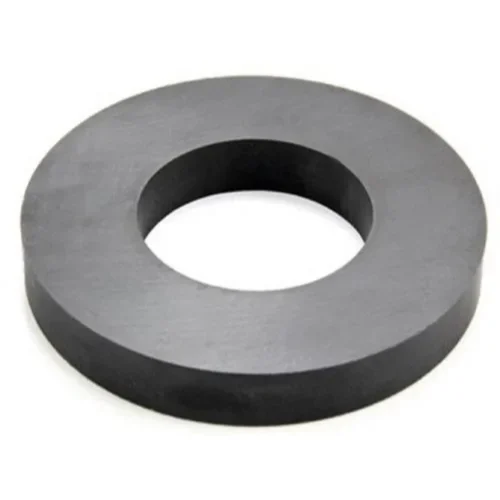
A ring magnet ceramic is a highly versatile and widely used component in physics laboratories, educational institutions, and research settings, designed to facilitate the study of magnetic properties and their applications. Its unique circular ring shape makes it particularly effective for a variety of experiments, as it allows for easy handling and integration into scientific setups. Ceramic magnets are known for their durability, stability, and strong magnetic properties, making them an ideal choice for repeated laboratory use. In educational environments, these magnets are essential for providing students with practical exposure to magnetic fields, polarity, and the interaction of magnets with different materials, helping to strengthen their understanding of theoretical physics concepts through direct, hands-on experimentation.
Description
Manufactured from high-quality ceramic materials, the ring magnet is resistant to demagnetization, corrosion, and wear, ensuring long-lasting performance even under continuous use in physics labs. This makes it an economical and reliable tool for both simple demonstrations and complex scientific experiments. The ring shape offers a unique advantage because it provides a consistent magnetic field along its edges and around its central hole, enabling more precise demonstrations of how magnets interact with other components. For example, the magnet can be easily mounted on rods, axles, or used in conjunction with coils to demonstrate principles of electromagnetic induction, making it a valuable resource for both school-level physics and advanced studies in engineering and applied sciences.
In physics labs, a ceramic ring magnet is commonly used to illustrate concepts such as attraction and repulsion, magnetic flux, and the influence of magnetic fields on conductive and non-conductive materials. When paired with iron filings, it provides a clear visualization of magnetic field lines, helping students to see and understand the invisible forces at work. It is also widely employed in experiments involving electromagnetism, motors, and generators, offering learners the opportunity to explore real-world applications of magnetism in technology and industry. This practical approach not only enhances comprehension but also encourages curiosity and experimentation among students, making the learning experience more engaging and memorable.
The durability of ceramic material ensures that the magnet retains its strength and efficiency over time, making it a cost-effective addition to any educational laboratory. Its resistance to external factors such as temperature variations and corrosion ensures reliable performance, even with frequent use in a busy academic environment. The ring magnet is also lightweight and easy to handle, which makes it suitable for younger students as well as advanced learners, allowing teachers to adapt its use across different grade levels and curricula.
Beyond classroom learning, the ceramic ring magnet also finds application in demonstration models for scientific fairs, project work, and hobby experiments. Its role in showcasing how magnetic forces contribute to technological innovations like loudspeakers, sensors, and other electronic devices makes it an important educational tool for connecting classroom theory to real-life applications. By incorporating a ring magnet ceramic into laboratory activities, educators provide students with a deeper and more practical understanding of magnetic phenomena, encouraging the development of problem-solving skills, scientific reasoning, and a passion for exploration in the field of physics and beyond.