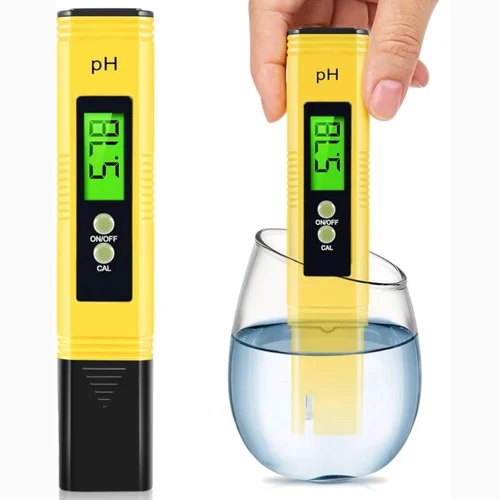
A pH meter is a precision scientific instrument designed to measure the acidity or alkalinity of liquids with accuracy, reliability, and ease, making it an essential tool across educational laboratories, research environments, and industrial training settings. This device provides a digital reading of pH values, enabling students and trainees to understand chemical characteristics of various solutions while developing essential laboratory skills. The meter typically consists of a sensitive glass electrode and a reference electrode, working together to detect hydrogen ion activity in a sample. As the electrodes are immersed in a solution, the meter interprets the electrical potential difference and converts it into an accurate pH value displayed on the screen. This allows users to quickly and confidently determine whether a substance is acidic, neutral, or alkaline.
Description
In educational institutions, the pH meter plays a vital role in chemistry, biology, environmental science, and applied science labs. Its straightforward operation helps learners grasp fundamental scientific concepts such as chemical reactions, solution equilibrium, and the importance of pH in biological systems, water quality, soil science, and industrial processes. Students are able to practice proper measurement techniques, calibration procedures, and sample handling, reinforcing both theoretical knowledge and practical competence. The digital display offers clear, instant readings, reducing the chance of human error and making the instrument especially suitable for beginners who are still becoming familiar with laboratory equipment.
Engineered for accuracy, the pH meter often features automatic temperature compensation, which ensures that readings remain correct even when samples vary in temperature. This enhances the learning experience by demonstrating how external factors influence chemical measurements. The device is typically constructed with durable materials and a robust outer casing to withstand frequent use in educational settings. The electrode system is designed for high sensitivity, offering quick response times and stable readings. Many models allow easy electrode replacement, ensuring long-term usability and consistent performance.
Calibration is a key aspect of using a pH meter, and the instrument is generally compatible with standard buffer solutions, allowing students to perform single-, two-, or three-point calibration depending on the experiment. Through this routine, learners gain hands-on experience in accurate instrument preparation and quality control. This reinforces good laboratory practice and helps them develop confidence in using analytical instruments. The user-friendly interface, often equipped with simple control buttons, makes the meter ideal for repeating experiments, conducting comparative studies, and supporting inquiry-based learning activities.
A pH meter is also valuable for environmental monitoring exercises, where students can test pH levels in water bodies, soil samples, and environmental runoff to understand pollution levels, ecological balance, and agricultural conditions. Its portability makes it suitable for both classroom use and fieldwork. Its consistent performance and digital precision make it a dependable tool for experiments involving titrations, fermentation studies, plant growth investigations, and chemical solution preparation.
Overall, the pH meter is a versatile and highly effective educational instrument that supports accurate measurement, scientific inquiry, and hands-on learning. Its combination of precision, durability, and ease of operation makes it a fundamental piece of equipment for schools, colleges, and training laboratories seeking to enhance their scientific capabilities.