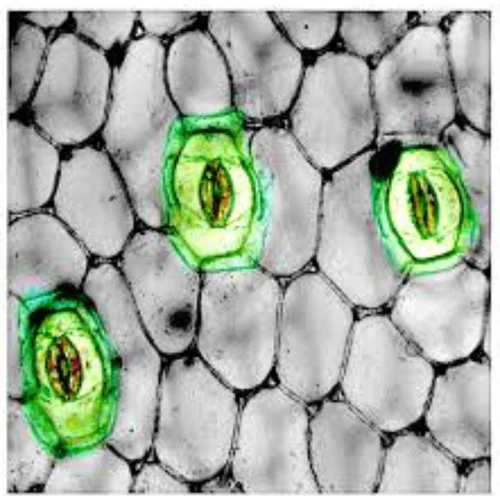
The permanent slide of stomata of monocot plants is a finely prepared botanical specimen that provides a clear and detailed microscopic view of the stomatal structure and arrangement in monocotyledonous species. This slide serves as an essential educational and research tool for studying the unique features of monocot stomata, which differ in form, distribution, and arrangement from those found in dicot plants. Stomata are tiny openings located primarily on the epidermis of leaves, playing a vital role in gas exchange and regulating water loss through transpiration. In monocot plants, the stomata exhibit a distinct parallel arrangement along the veins of the leaf, often with dumbbell-shaped guard cells, making them a key point of study in plant anatomy and physiology. By using this permanent slide under a microscope, students, educators, and researchers can clearly observe guard cells, subsidiary cells, and the stomatal pore, gaining valuable insight into their structure and functional role in plant metabolism.
Description
The preparation of this permanent slide ensures exceptional clarity and preservation of microscopic details, allowing for long-term use in academic and research settings. The sample is carefully obtained from the epidermis of a monocot leaf, often from species commonly used in botanical studies, to present a representative and easily identifiable example of monocot stomatal structure. Through precise staining techniques, the contrast between guard cells, epidermal cells, and surrounding tissue is enhanced, enabling clear differentiation of cellular components during microscopic observation. The unique dumbbell-shaped guard cells found in monocots can be easily identified, providing an excellent visual reference for comparative studies with dicot stomata. This allows learners to understand the morphological adaptations of monocot plants to their environment and how these adaptations influence their physiological processes.
In educational environments, this permanent slide is an invaluable teaching aid for explaining plant anatomy, particularly in lessons focused on stomatal function, leaf epidermis structure, and the differences between monocot and dicot plants. It helps students understand how the structural features of monocot stomata support their primary function of regulating gas exchange and water loss, while also adapting to different climatic and ecological conditions. Observing this slide allows learners to connect theoretical knowledge about photosynthesis, transpiration, and plant respiration to real microscopic evidence, deepening their comprehension of these vital biological processes.
The slide is mounted on high-quality glass with a protective cover slip and is permanently sealed to prevent damage, deterioration, or contamination. This ensures its durability, allowing it to withstand repeated handling in classrooms, laboratories, and research facilities. The specimen is compatible with both standard compound microscopes and advanced digital imaging systems, making it suitable for traditional and modern learning setups. The high-quality preservation of details enables consistent and accurate observations, benefiting students, educators, and researchers across various academic levels.
It can be used in fields such as agriculture, plant breeding, environmental science, and climate studies, where understanding stomatal behavior is crucial for assessing plant health, productivity, and adaptability. Since stomata are directly linked to a plant’s water regulation and photosynthetic efficiency, studying their morphology in monocots provides essential insights into crop management, irrigation planning, and environmental adaptation strategies. This permanent slide offers a reliable, high-quality resource for accurate microscopic observation, making it an indispensable tool in the study of plant biology and physiology.