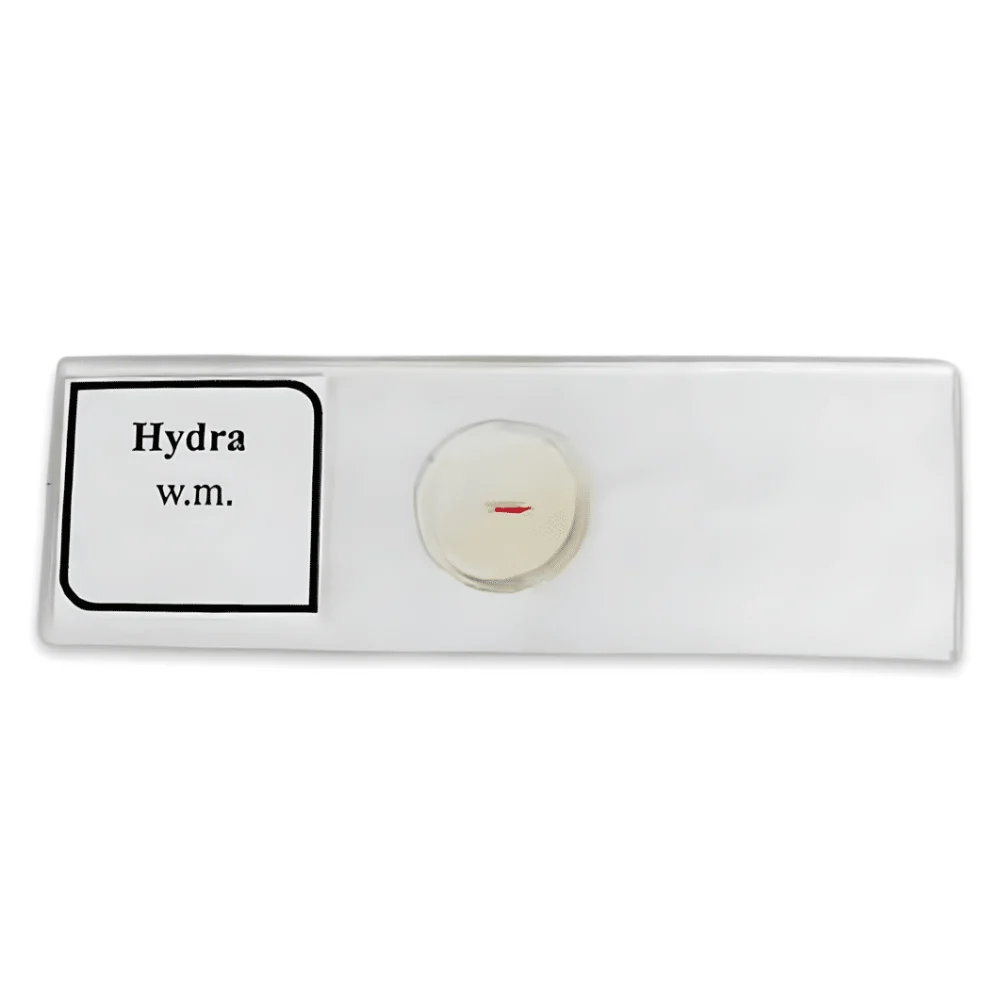
The permanent slide of Hydra showing budding is an essential educational and biological research tool designed to illustrate a key method of asexual reproduction in multicellular organisms. This high-quality slide captures Hydra, a freshwater cnidarian, during the budding process, which is a prime example of how certain animals reproduce without the involvement of gametes. The slide is meticulously prepared to preserve the structural details of the parent Hydra and the developing bud, enabling educators, students, and researchers to examine and understand the intricacies of this regenerative and reproductive phenomenon under a microscope. It is an ideal addition to biology lab kits, school science labs, and higher education institutions focused on zoology and developmental biology.
Description
Budding in Hydra is a fascinating biological process where a new individual grows directly from the body of the parent organism. This form of asexual reproduction involves the mitotic division of cells, which then differentiate into specialized tissues and organs to form a genetically identical offspring. On this permanent slide, the process is captured in a visually clear and scientifically accurate manner, showing the small bud protruding from the body wall of the adult Hydra. The slide is stained with safe biological dyes to enhance contrast, making the cellular structures such as tentacles, body stalk, and the point of attachment between the bud and the parent more distinguishable under light microscopy.
Hydra serves as a model organism in biological studies due to its simple body plan, regenerative abilities, and observable reproductive behaviors. The permanent slide is valuable for academic demonstrations, as it allows students to witness a real-life example of budding, supporting theoretical learning with hands-on observation. Teachers and instructors can use the slide to highlight topics like cell division, tissue differentiation, and regeneration. It also aids in explaining broader biological concepts such as growth, reproduction, and evolutionary biology in the context of lower invertebrates. Furthermore, it can be a reference slide for biology practical exams, allowing learners to identify and label key anatomical parts of Hydra and the budding region.
The slide is mounted on durable optical-grade glass and sealed with a clear cover slip to protect the specimen from environmental damage, ensuring long-lasting clarity and usability. It fits all standard microscopes and is compatible with digital imaging systems, making it versatile for traditional classroom use as well as modern digital teaching setups. The permanent slide of Hydra showing budding is also an important tool for research labs studying morphogenesis, developmental biology, and regeneration. By analyzing the budding Hydra, researchers can gather insights into how cells coordinate and organize to form a complete organism—a topic of interest in regenerative medicine and evolutionary developmental biology.
In addition to educational and research purposes, the slide is valuable for museum exhibits and public science education centers aiming to promote biological awareness. Its clarity, durability, and detailed preservation make it suitable for display and repeated use. The well-defined specimen on the slide ensures that every detail, from the main body of the Hydra to the emerging bud, is visible and accessible for in-depth study. Overall, the permanent slide of Hydra showing budding is a scientifically rich and visually informative resource that supports foundational learning and advanced research in biological sciences.