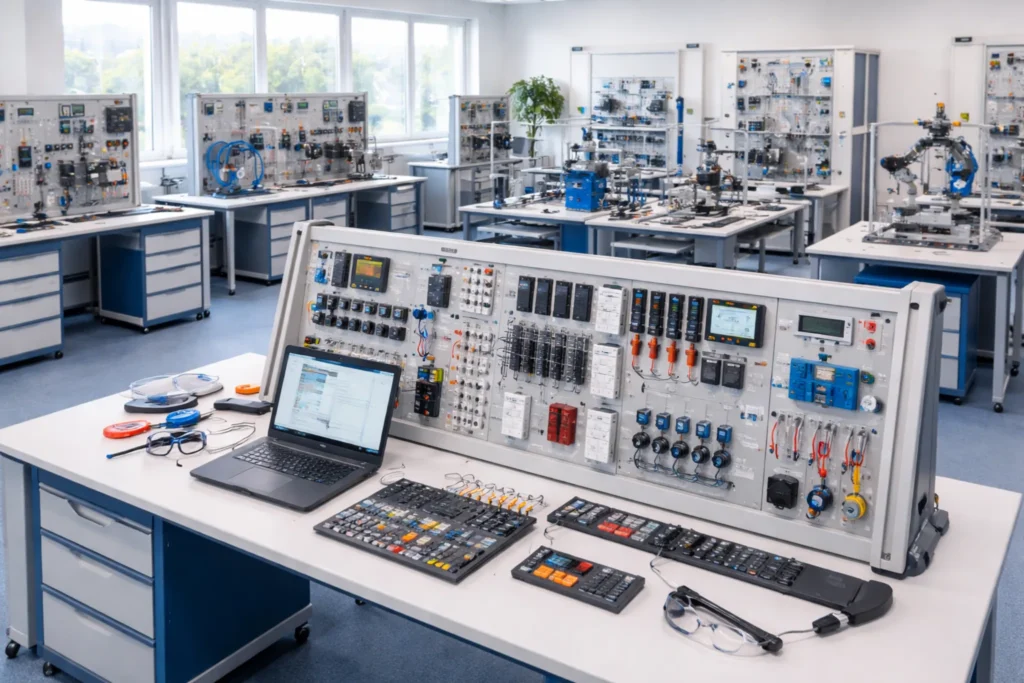
Setting up a TVET training laboratory is an important step for institutions that want to provide practical technical education. A well-designed laboratory allows students to gain hands-on experience, understand engineering concepts, and develop real industry skills. Therefore, careful planning, proper equipment selection, and a structured training environment are essential for building an effective TVET lab.
Identify Training Programs and Laboratory Requirements
The first step in establishing a TVET laboratory is identifying the training programs the institute will offer. Different technical disciplines require different laboratory setups. For example, electrical engineering, electronics, mechanical engineering, and renewable energy training each require specialized equipment and experiment systems.
Institutions should analyze the curriculum and define the practical skills students must develop. This approach helps determine the required laboratory equipment, experiment modules, safety systems, and workspace design.
Select the Right Training Equipment
After defining the laboratory objectives, institutions should select appropriate TVET training equipment and engineering laboratory systems. Practical training equipment helps students understand theoretical concepts through real experiments and demonstrations.
Modern training laboratories typically include:
- Electrical and electronics training systems
- Mechanical and automation training equipment
- Renewable energy training systems
- Instrumentation and control training setups
Institutions can explore a wide range of technical training systems and laboratory solutions in this product showcase:
https://www.aseducationalkits.com/products-showcase/
Additionally, specialized training and skill development equipment for technical education can be explored here:
https://interlabs.in/product-category/training-and-skill-development/
Design a Safe and Efficient Laboratory Layout
A well-organized laboratory layout improves safety and learning efficiency. Therefore, training laboratories should include clearly defined experiment areas, equipment stations, storage sections, and instructor demonstration zones.
Adequate ventilation, electrical safety systems, and proper workspace lighting are also important. Furthermore, laboratories should follow international safety standards and include clear experiment guidelines for students.
Provide Supporting Laboratory Tools and Glassware
In addition to training systems, many laboratories require supporting equipment such as measuring instruments, testing devices, and scientific glassware. For example, laboratories involved in chemistry or analytical training may require beakers, flasks, and measuring cylinders.
You can explore a collection of laboratory beakers and scientific glassware here:
https://www.iwaki-pyrex.com/products-category/beakers/
These essential laboratory tools support accurate experiments and help students understand scientific processes.
Train Instructors and Develop Practical Modules
A successful TVET laboratory also depends on well-trained instructors. Therefore, institutes should develop structured experiment modules, training manuals, and demonstration exercises. Instructors should guide students through experiments while emphasizing safety, accuracy, and problem-solving skills.
Conclusion
A well-planned TVET training laboratory plays a crucial role in modern technical education. By selecting the right equipment, designing safe laboratory spaces, and providing structured training programs, institutions can create an effective learning environment for future engineers and technicians.
Through proper laboratory infrastructure and quality training systems, TVET institutes can strengthen technical education and prepare students for real-world industry challenges.