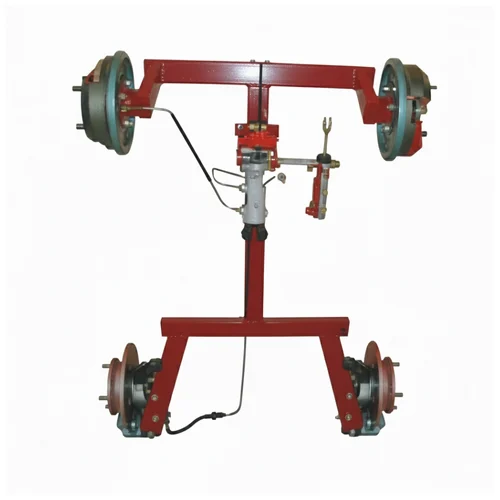
Hydraulic Brake Unit with Four Brake Drums – Engineering Training SystemThe Hydraulic Brake Unit with Four Brake Drums is a comprehensive teaching aid showcasing the principles and mechanics of hydraulic braking systems. It is widely employed in polytechnic colleges, engineering institutes, and vocational training centers globally, aligning with the latest curricular requirements and tender specifications of major donor agencies such as the World Bank, Asian Development Bank (ADB), and African Development Bank (AfDB).
Description
Product Overview : Hydraullic Brake Unit With Four Brake Drum
The Hydraulic Brake Unit With Four Brake Drum is a carefully designed educational working model created to support practical learning in mechanical and automobile engineering laboratories. This model allows students to observe and understand hydraulic braking systems through direct interaction and guided demonstrations. Since theory alone cannot explain real-world behavior, this working model connects classroom concepts with practical understanding in a simple and effective way.
By using this model, instructors can clearly explain how hydraulic braking systems function under controlled conditions. As a result, students gain stronger conceptual clarity and improved retention during laboratory sessions.
Working Principle and Demonstration : Hydraullic Brake Unit With Four Brake Drum
This educational unit demonstrates how hydraulic pressure is generated and transmitted through fluid to multiple brake drums. The system distributes braking force evenly across four drums, which helps students study balance and synchronization in braking mechanisms. Moreover, learners can visually observe how pressure application affects braking response.
Because all major components remain visible, students can easily follow the working sequence. Therefore, the model improves engagement and makes complex hydraulic principles easier to understand during demonstrations.
Design and Safety for Academic Use
The Hydraulic Brake Unit With Four Brake Drum uses durable materials that support repeated use in classrooms and laboratories. The model operates at low pressure, which ensures safe handling during demonstrations. In addition, the controlled design allows instructors to explain braking behavior without exposing students to industrial-level hazards.
Since the model focuses on education rather than industrial output, it remains ideal for regular academic use. Furthermore, its stable construction ensures reliable performance throughout multiple academic sessions.
Learning Outcomes and Educational Value
This working model simplifies important hydraulic concepts such as Pascal’s law, pressure transmission, and braking efficiency. Through step-by-step demonstrations, students can clearly understand system operation and component interaction. As a teaching aid, the model encourages curiosity, discussion, and active participation during lab experiments.
Because the setup supports hands-on learning, it strengthens both theoretical knowledge and practical skills among learners.
Suitable Academic Applications
This educational brake unit is commonly used in diploma programs, undergraduate engineering courses, and technical training institutes. Since it aligns with standard mechanical and automobile engineering curricula, it fits easily into existing lab setups. Additionally, its compact size allows convenient placement on laboratory benches while maintaining clear visibility of all parts.
Conclusion
Overall, the Hydraulic Brake Unit With Four Brake Drum serves as an effective educational tool that enhances practical understanding of hydraulic braking systems. Because it focuses entirely on learning and demonstration, it remains a valuable addition for institutions aiming to improve hands-on engineering education.
This unit features a fully functional hydraulic brake system equipped with four brake drums and two master cylinders. Mounted securely on a heavy wooden base, the system also includes fluid lines and components demonstrating pedal operation, hydraulic pressure transmission, and braking action. One of the master cylinders is kept in operational condition for accurate representation of real-world braking systems.
Key Features
- Complete hydraulic brake system with four brake drums and dual master cylinders.
- Mounted on a heavy, stable wooden base for classroom or laboratory use.
- Operational master cylinder to demonstrate fluid pressure generation.
- High-quality components illustrating pedal linkage, fluid transmission, and brake actuation.
- Designed for robustness and durability in educational settings.
- Educational BenefitsProvides practical understanding of hydraulic brake system operation and maintenance.
- Supports comprehensive coverage of automotive brake systems in engineering and vocational curricula.
- Develops skills in diagnosis, adjustment, and repair of hydraulic braking mechanisms.
- Enhances safety awareness and technical competence in brake system technology.
- Facilitates hands-on learning complementing theoretical studies.
- Tender ComplianceManufactured in accordance with international standards for procurement by donor-funded educational projects.
Ensures longevity and reliability with minimal maintenance demands.
Comes with detailed instructional manuals and user guides tailored for academic environments.
Suitable for modern laboratories integrating digital measurement and control systems.
ApplicationsPolytechnic and engineering colleges focusing on automotive technology.
Vocational training institutions preparing skilled technicians for the automotive industry.
Automotive repair shops used for practical training and demonstration.
Development programs aimed at enhancing technical education in transportation sectors.
Applications
- Engineering college laboratories
- Polytechnic and diploma institutes
- Automobile engineering training labs
- Technical education and skill development centers
- Classroom demonstrations and practical exams
This educational working model can be effectively integrated with other educational working models and laboratory kits to enhance hands-on learning in engineering and technical laboratories. In addition, institutions may also explore complementary learning solutions such as Jaadui Pitara educational learning kits to support interactive and concept-based education.