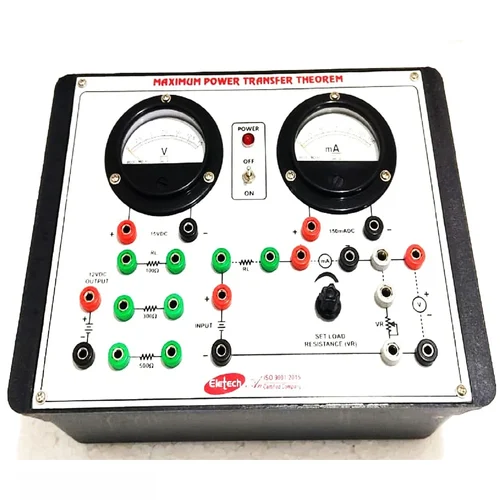
The maximum power transfer theorem apparatus is a specialized educational equipment designed to provide hands-on learning and a clear practical demonstration of one of the most important principles in electrical engineering. This apparatus is built to help students and learners understand the fundamental concept that maximum power is transferred from a source to a load when the load resistance matches the internal resistance of the source. By offering a tangible way to study this principle, the apparatus becomes an essential tool for electrical laboratories, engineering institutions, and technical training centers where experimental learning forms the core of knowledge building.
Description
Product Overview : Maximum Power Transfer Theorem
The Maximum Power Transfer Theorem educational working model helps students understand an important concept in electrical and electronics engineering. This working model enables learners to study how power transfer changes with different load conditions. Because students often find the concept abstract, this model improves clarity through clear and practical demonstration.
Principle of Maximum Power Transfer : Maximum Power Transfer Theorem
This educational model shows that the load receives maximum power when the load resistance equals the internal resistance of the source. As a result, students can directly observe how resistance matching influences power delivery. Moreover, the setup helps learners understand the relationship between voltage, current, and power in electrical circuits.
Working and Experimental Setup
Students can vary the load resistance using the working model and record the corresponding readings. Therefore, learners measure voltage and current while calculating power at each stage of the experiment. Since the process follows a step-by-step method, students can easily repeat experiments and confirm theoretical results during lab sessions.
Design and Safety Features
The Maximum Power Transfer Theorem model suits academic use and classroom demonstrations. It operates at safe voltage levels, which allows controlled handling in laboratories. In addition, the sturdy construction supports repeated demonstrations without reducing accuracy. Because of the clear layout, instructors explain each component easily and without confusion.
Learning Outcomes and Educational Value
This working model strengthens understanding of power efficiency, load matching, and energy transfer. Through hands-on experimentation, students build stronger analytical and problem-solving skills. Furthermore, the model promotes active participation, which improves concept retention and examination performance.
Suitable Academic Applications
Educational institutions use this working model in diploma courses, undergraduate engineering programs, and technical training institutes. Since it matches standard electrical and electronics engineering curricula, it fits smoothly into existing laboratory syllabi. Additionally, the compact design allows easy placement on lab benches.
Conclusion
Overall, the Maximum Power Transfer Theorem educational working model enhances both theoretical knowledge and practical understanding. Because the model focuses entirely on demonstration and learning, it serves as a reliable teaching aid for engineering education.
This educational working model can be effectively integrated with other educational working models and laboratory kits to enhance hands-on learning in engineering and technical laboratories. In addition, institutions may also explore complementary learning solutions such as Jaadui Pitara educational learning kits to support interactive and concept-based education.