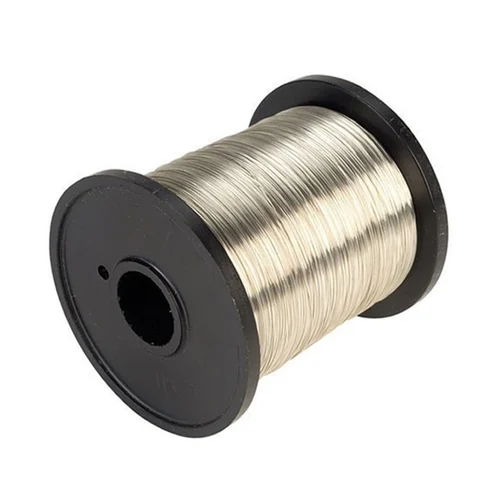
The standard 38 SWG fuse wire is an essential electrical safety component used widely across residential, commercial, and educational applications to protect circuits from overloads and short circuits. Crafted with precision and consistency, this fuse wire ensures a reliable and safe solution for electrical systems that require a fail-safe mechanism to prevent potential hazards such as equipment damage, overheating, or fire. Its primary function is to interrupt the flow of electric current when it exceeds a predetermined level, thereby safeguarding the integrity of connected devices and wiring systems.
Description
Product Overview : Fuse Wire Standard
Fuse Wire Standard (38 SWG) is a fine electrical protection wire designed for low-current circuits used in schools and technical institutes across India, South Africa, Nigeria, Kenya, Egypt, and Ethiopia. It helps students observe circuit protection in real time during experiments. Therefore, learners can clearly understand how overcurrent causes circuit interruption.
Wire Gauge and Electrical Characteristics : Fuse Wire Standard
This fuse wire uses a 38 Standard Wire Gauge (SWG), which makes it exceptionally thin and sensitive to current variation. As a result, it suits low-current applications where precise response matters. Moreover, the uniform thickness ensures predictable melting behavior during demonstrations.
Circuit Protection and Working Principle
The fuse wire melts quickly when current exceeds safe limits. Consequently, it breaks the circuit and prevents damage to other components. This clean and fast response allows students to observe the principle of electrical safety clearly without sparks or excessive residue.
Educational and Laboratory Applications
In physics and electronics laboratories, students use this fuse wire to study current flow, resistance, and circuit protection. Teachers often include it in school projects and basic electronics experiments. Therefore, learners gain hands-on understanding of electrical safety concepts taught in theory.
Practical and Technical Use
The fuse wire fits easily into standard fuse holders, where it forms a controlled break point between terminals. Because of its fine diameter, it works well in delicate circuits such as small motors, testing rigs, and low-load domestic devices. In addition, hobbyists use it widely in DIY electronics and prototyping work.
Material Quality and Performance Consistency
The wire is manufactured from a metal alloy with good conductivity and a calibrated melting point. As a result, it reacts consistently under defined current limits. This reliability helps maintain accuracy in experiments and improves safety during repeated use.
Handling, Storage, and Compatibility
The fuse wire is supplied in compact coils or spools for easy storage and dispensing. Its lightweight nature makes it convenient for laboratory benches and toolkits. Moreover, the standard gauge ensures compatibility with commonly used fuse holders and connectors.
Educational Benefits and Learning Outcomes
By using standard fuse wire, students develop a clear understanding of electrical protection and current limitation. Practical observation improves retention and analytical thinking. Furthermore, repeated experimentation builds confidence in handling basic electrical components safely.
Conclusion
Overall, Fuse Wire Standard (38 SWG) is a simple yet essential component for electrical education. Because it combines precision, safety, and ease of use, it remains a trusted choice for classrooms, laboratories, and basic electrical experimentation.
This educational working model can be effectively integrated with other educational working models and laboratory kits to enhance hands-on learning in engineering and technical laboratories. In addition, institutions may also explore complementary learning solutions such as Jaadui Pitara educational learning kits to support interactive and concept-based education.