Laboratory Apparatus and Uses in Science Education
Understanding laboratory apparatus and uses is essential for effective science education and safe practical experiments. From basic school laboratories to advanced senior secondary classrooms, laboratory tools help students perform experiments accurately while developing strong scientific understanding. Practical learning encourages students to observe, analyze, and apply theoretical concepts, which makes science more engaging and meaningful.
Importance of Laboratory Apparatus in Practical Learning
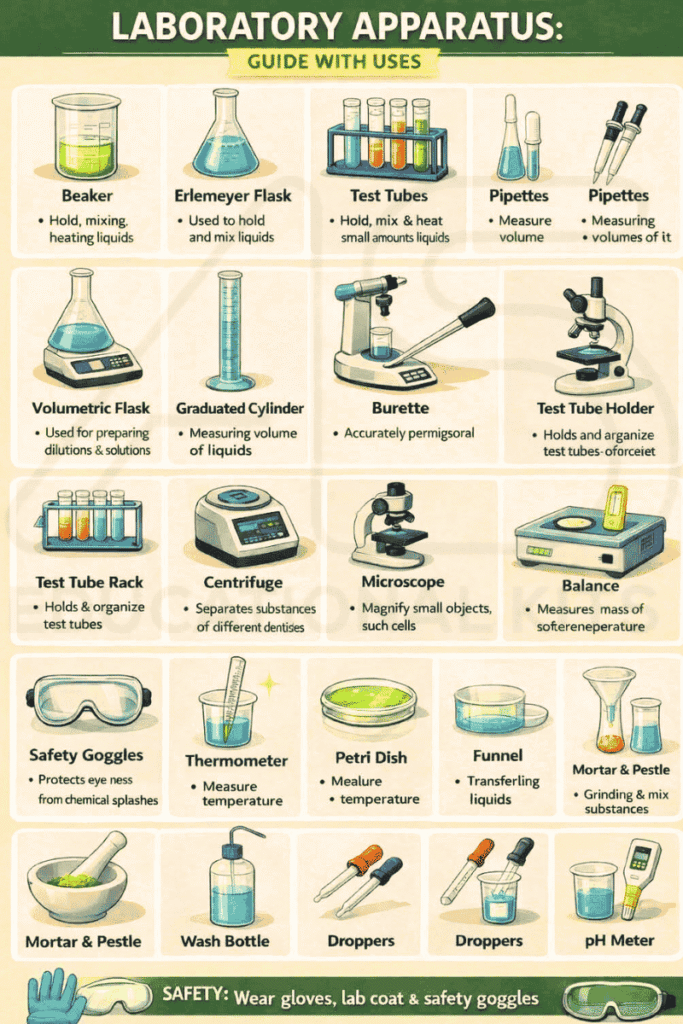
Each laboratory apparatus serves a specific purpose in scientific experiments. Tools such as beakers, test tubes, flasks, pipettes, and graduated cylinders are commonly used for holding, mixing, heating, and measuring liquids. These instruments allow students to conduct experiments with precision while maintaining consistency in results. As students progress, they learn how proper handling of laboratory equipment improves accuracy and safety.
Common Laboratory Apparatus and Their Uses
Advanced instruments play a crucial role in experimental learning. Microscopes help students observe microscopic structures, while centrifuges assist in separating substances based on density. Balances support accurate mass measurement, and pH meters help determine acidity and alkalinity levels. Understanding laboratory apparatus and uses enables students to perform experiments confidently while following correct laboratory procedures.
Safety Equipment Used in Laboratories
Safety remains a key part of practical science education. Equipment such as safety goggles, wash bottles, test tube holders, and racks helps create a controlled and secure laboratory environment. When students learn to use safety tools correctly, they develop responsible laboratory habits that are essential for long-term scientific learning.
Educational Kits and Laboratory Apparatus for Students
At our platform, we focus on providing high-quality educational kits and laboratory apparatus designed for early learners, school students, and senior secondary education. By combining visual explanations with practical laboratory tools, we support hands-on learning and concept clarity. This structured approach helps teachers and institutions deliver meaningful experiments while encouraging curiosity and critical thinking.
The laboratory glassware industry continues to grow as research and educational laboratories upgrade essential equipment. Glass condensers support accurate distillation and reflux processes across academic, pharmaceutical, and industrial facilities. Reliable borosilicate condenser designs improve thermal performance and chemical resistance in modern labs. Learn more about advanced condenser options here:
https://www.iwaki-pyrex.com/products-category/laboratory-glassware-condensers-borosilicate-lab-condenser/
Growing adoption is visible across India, Germany, France, Italy, Ireland, Indonesia, Ghana, Greece, Finland, and Israel. To support this demand, laboratories also invest in compatible laboratory glassware systems available internally at:
https://www.aseducationalkits.com/products-category/laboratory-glassware/