
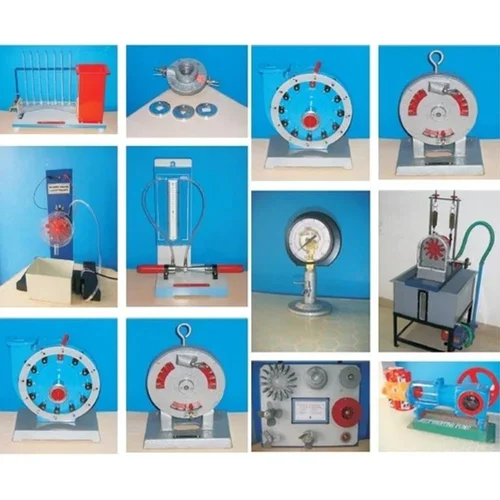
Hydraulics & Fluid Mechanics lab equipment helps study fluid behavior (static/dynamic) using tools like Manometers (pressure), Flowmeters (rate), Venturi/Orifice Meters (flow measurement/calibration), Bernoulli’s Apparatus (energy conservation), Pipe Friction Rigs (head loss), and Pumps/Turbines (energy conversion), all often powered by a Hydraulic Bench for controlled water supply, demonstrating principles like Bernoulli’s theorem, fluid friction, and pump/turbine efficiency for real-world engineering.
Description
Hydraulics Fluid Mechanics Lab Equipment for Studying Fluid Behavior
Hydraulics Fluid Mechanics Lab Equipment enables students to study both static and dynamic behavior of fluids through controlled laboratory experiments. Using water as the working medium, learners can observe pressure variation, flow characteristics, and energy transfer in real time. This practical exposure helps bridge the gap between theory and real-world engineering applications.
Hydraulics Fluid Mechanics Lab Equipment for Measurement and Analysis
The laboratory setup typically includes manometers for pressure measurement, flowmeters for discharge calculation, and Venturi or orifice meters for flow calibration. These instruments allow students to analyze fluid flow accurately. As a result, concepts such as continuity, velocity distribution, and pressure variation become easier to understand.
Demonstrates Core Fluid Mechanics Principles
Apparatus such as Bernoulli’s theorem setup and pipe friction rigs help demonstrate energy conservation and head loss in pipelines. Students can compare theoretical results with experimental data, which strengthens analytical and problem-solving skills. These experiments also explain the effect of friction and surface roughness on fluid flow.
Supports Study of Pumps and Turbines
Pumps and turbine models included in the lab help learners understand energy conversion in hydraulic systems. Students can evaluate efficiency, input power, output power, and performance curves. Therefore, the lab supports applied learning in areas related to water resources, mechanical systems, and renewable energy.
Operated Using a Hydraulic Bench
A hydraulic bench provides a controlled and continuous water supply to all experimental units. It ensures safe operation, easy flow regulation, and consistent results across experiments. This centralized setup improves lab efficiency and reduces setup time during practical sessions.
Suitable for Engineering and Technical Institutions
Hydraulics Fluid Mechanics Lab Equipment is widely used in engineering colleges, polytechnics, and technical training institutes. Instructors rely on it for demonstration-based teaching, while students use it for hands-on experimentation aligned with academic curricula.
This equipment is intended strictly for education and demonstration use only and not for industrial testing or commercial hydraulic operations. Overall, Hydraulics Fluid Mechanics Lab Equipment provides a comprehensive platform for understanding fluid behavior, measurement techniques, and hydraulic energy systems in a structured learning environment.
other educational working models and laboratory kits to enhance hands-on learning in engineering and technical laboratories. In addition, institutions may also explore complementary learning solutions such as Jaadui Pitara educational learning kits to support interactive and concept-based education.
See also different:
Wood Working Machines for Workshop and Training Use
Heat Transfer Laboratory Equipment for Engineering Education