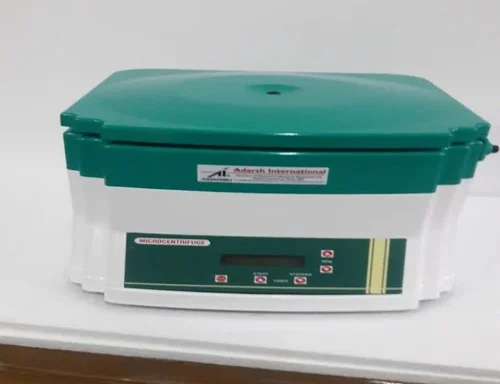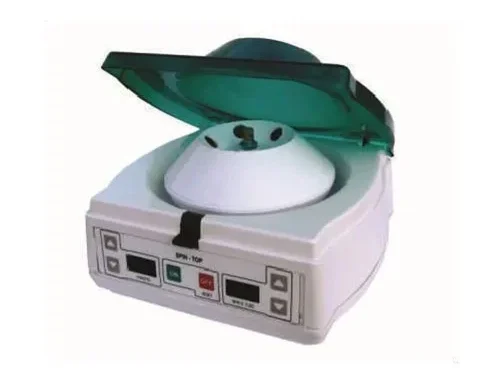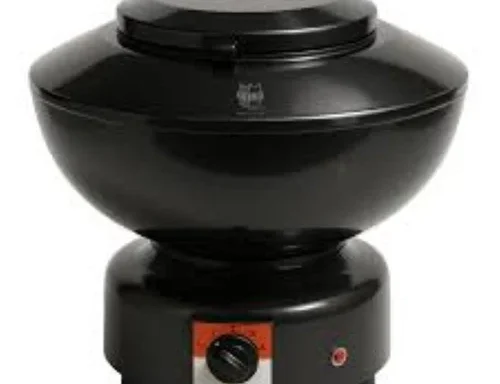
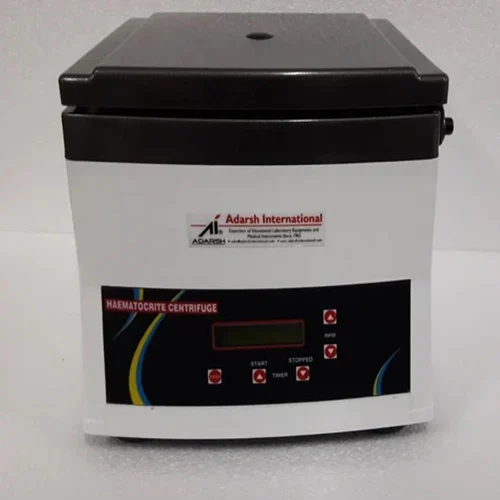
In labs, centrifuges use high-speed spinning to separate substances by density, crucial for separating blood components (plasma, red cells) in medicine, isolating DNA/RNA/proteins in biotech, purifying cellular parts (organelles), concentrating samples (pelleting cells), and analyzing particle properties like size/shape, essential for research from diagnostics to material synthesis. They are vital tools across biology, chemistry, and clinical labs, with various types (micro-, ultra-, refrigerated) for specific needs like small-volume or temperature-sensitive samples.
Description
The Laboratory Centrifuge Machine plays a key role in educational and demonstration laboratories where students learn density-based separation techniques. It spins samples at controlled speeds, allowing learners to observe how substances with different densities separate under centrifugal force. As a result, it strengthens conceptual understanding in biology, chemistry, and medical science.
Educational institutions across India use this machine widely for classroom experiments. Likewise, universities and training laboratories in countries such as Germany, the United States, and Japan rely on centrifuges to teach foundational laboratory workflows.
Laboratory Centrifuge Machine for Blood and Sample Separation
The Laboratory Centrifuge Machine helps students clearly understand blood component separation, including plasma and red blood cells. Teachers often use it during demonstrations to explain how basic diagnostic processes work. In addition, learners use it to separate urine samples and simple liquid mixtures during routine practical sessions.
Moreover, the machine visually explains sedimentation principles. Heavier particles move outward during rotation, while lighter components remain above. Therefore, students grasp these concepts faster through hands-on observation rather than theory alone.
Laboratory Centrifuge Machine for Molecular and Cellular Learning
The Laboratory Centrifuge Machine supports introductory learning in biotechnology and life sciences. Instructors commonly use it to demonstrate DNA, RNA, and protein isolation at a conceptual level. Furthermore, it helps explain cell pelleting and organelle separation during training experiments.
Different centrifuge types, such as micro and refrigerated models, often appear in demonstrations to explain sample volume and temperature sensitivity. Consequently, students gain exposure to real-world laboratory practices used in academic research globally.
Safe Design and Consistent Performance
The machine features a stable rotor and controlled speed settings, which allow safe operation during teaching sessions. As a result, instructors can focus on explaining scientific principles without equipment complexity. Additionally, the compact design fits easily on standard laboratory benches.
Intended for Education and Demonstration Use Only
This centrifuge machine supports education, training, and demonstration use only. It does not target industrial processing, clinical diagnostics, or commercial research. Instead, it promotes safe learning, skill development, and foundational laboratory understanding.
Applications
- Demonstration of blood component separation
- Learning DNA, RNA, and protein isolation
- Teaching cell pelleting and organelle separation
- Sample concentration experiments
- Classroom and academic laboratory training
other educational working models and laboratory kits to enhance hands-on learning in engineering and technical laboratories. In addition, institutions may also explore complementary learning solutions such as Jaadui Pitara educational learning kits to support interactive and concept-based education.