
A DIAC (Diode for Alternating Current) is a bidirectional semiconductor switch used primarily to trigger TRIACs in AC power control, featuring symmetrical conduction after exceeding a specific breakover voltage (VBOcap V sub cap B cap O end-sub𝑉𝐵𝑂), and its characteristics (V-I curve showing negative resistance) are studied using an apparatus that applies AC voltage to plot its distinctive “S” or “M” shaped curve, revealing its breakover/holding points for smooth, phase-controlled power regulation in dimmers and motor speed controls.
Description
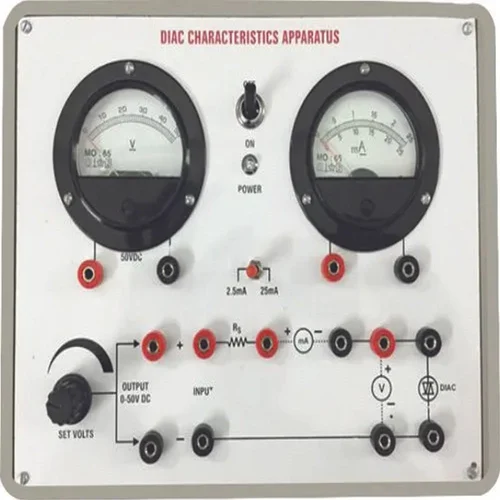
The DIAC Characteristic Apparatus is a laboratory teaching and demonstration unit designed to study the electrical characteristics of a DIAC (Diode for Alternating Current). It helps students visualize how a DIAC behaves under alternating voltage and how it switches conduction after reaching its breakover voltage. As a result, learners can clearly understand the role of DIACs in AC power control circuits.
Engineering colleges, polytechnic institutes, and electronics laboratories across India commonly use this apparatus for power electronics education. In addition, technical training centers in countries such as the United Kingdom, South Africa, and Kenya rely on DIAC characteristic setups to support practical learning in semiconductor devices.
DIAC Characteristic Apparatus for V–I Curve Study
The DIAC Characteristic Apparatus allows students to plot the voltage–current (V–I) characteristics of a DIAC under controlled AC input conditions. By gradually increasing the applied voltage, learners observe the point at which the DIAC reaches its breakover voltage (VBO) and begins conducting. Therefore, the concept of bidirectional conduction becomes easy to understand.
Because the DIAC conducts symmetrically in both half cycles of AC, the plotted curve appears in an “S” or “M” shape. Moreover, this distinctive curve helps students identify negative resistance regions and holding characteristics during conduction.
DIAC Characteristic Apparatus for Power Control Learning
The DIAC Characteristic Apparatus also supports understanding of practical power control applications. Teachers use it to explain how DIACs trigger TRIACs smoothly in phase-controlled circuits. Consequently, students can relate laboratory observations to real-world uses such as light dimmers, heater controllers, and motor speed regulators.
By studying the triggering behavior, learners understand why DIACs improve symmetry and reduce distortion in AC control systems. As a result, the apparatus builds a strong foundation for advanced topics in power electronics.
Stable Design and Clear Measurement Setup
The apparatus features a stable circuit layout with clearly marked terminals and measuring points. Additionally, built-in meters or external measurement connections allow accurate voltage and current readings. This clarity supports step-by-step experimentation and reliable plotting of characteristics.
Suitable for Education and Demonstration Use
This DIAC characteristic apparatus is suitable for engineering colleges, polytechnic institutes, electronics laboratories, vocational training centers, and power electronics demonstration labs. It aligns well with curricula covering semiconductor devices and AC power control.
Applications
- Studying DIAC V–I characteristics
- Understanding breakover and holding voltage
- Learning bidirectional semiconductor behavior
- Power electronics laboratory experiments
- Demonstration of AC phase control principles
For institutions and laboratories planning to expand their scientific infrastructure, a wide range of biology laboratory instruments and teaching aids is available at
https://www.aseducationalkits.com/products-category/biology-lab-equipments/
In addition, educators and procurement teams can explore a broader selection of educational science items and classroom resources at
https://www.labscientificequipments.com/product-category/educational-items/