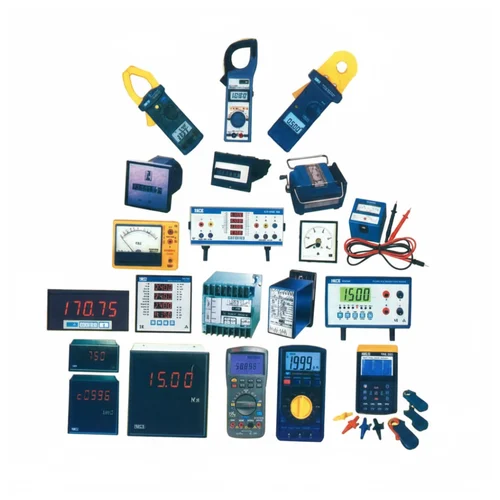
Electronics laboratory instruments are essential tools designed to facilitate hands-on learning, experimentation, and research in the field of electronics and electrical engineering. These instruments form the foundation of any modern educational laboratory, enabling students, educators, and researchers to practically explore theoretical concepts, analyze electronic circuits, and understand the real-world applications of electronics. They play a crucial role in strengthening the learning process by bridging the gap between theory and practice, offering opportunities to test, measure, and troubleshoot various electronic components and systems. Whether used for basic circuit experiments or advanced electronic system design, these instruments are indispensable in fostering technical expertise and problem-solving skills.
Description
Electronics laboratory instruments are essential tools for practical learning and experimentation in educational and professional environments. They allow students to work directly with test and measurement equipment, which helps bridge the gap between theory and real-world application. Because hands-on practice strengthens understanding, these instruments play a key role in studying electronic circuits, signal behavior, and system performance. Moreover, their accuracy and reliability support consistent results during experiments, which builds confidence and technical competence among learners.
Electronics Laboratory Instruments for Circuit Analysis and Measurement
In educational laboratories, electronics laboratory instruments such as oscilloscopes, function generators, regulated power supplies, and multimeters are used to analyze circuit behavior. Oscilloscopes help visualize waveforms and signals in real time, enabling students to understand voltage variation and signal timing. Function generators create different waveforms to test circuit responses, while regulated power supplies deliver stable voltage and current to components under test. Therefore, learners gain a clear understanding of how electronic circuits operate under controlled conditions.
Advanced Electronics Laboratory Instruments for Skill Development
Advanced electronics laboratory instruments, including logic analyzers, spectrum analyzers, and microcontroller trainers, support higher-level learning in digital electronics and embedded systems. These tools allow exploration of signal processing, communication electronics, and programmable systems. Consequently, students develop skills aligned with modern technological requirements. Educational institutions and technical training centers rely on these instruments to design structured experiments that match curriculum goals and industry expectations. Their user-friendly interfaces also make them suitable for beginners as well as advanced learners.
Electronics Laboratory Instruments in Research and Industrial Training
Beyond education, electronics laboratory instruments are widely used in research, development, and prototype testing. Their precision supports performance analysis and result validation in experimental setups. In addition, modern instruments often feature digital displays, microprocessor-based controls, and connectivity options, which enhance usability and data handling. Modular trainers and plug-and-play accessories further increase flexibility, allowing experiments to be customized for specific projects or learning objectives. For related educational and laboratory equipment, you may explore:
https://www.aseducationalkits.com/products-category/physics-lab-equipment/
For a broader range of laboratory and industrial electronics solutions, refer to:
https://interlabs.in/products-catalogue/
Applications
Educational electronics laboratory training
Circuit testing and signal analysis
Vocational and technical skill development
Research and development projects
Prototype testing and system validation