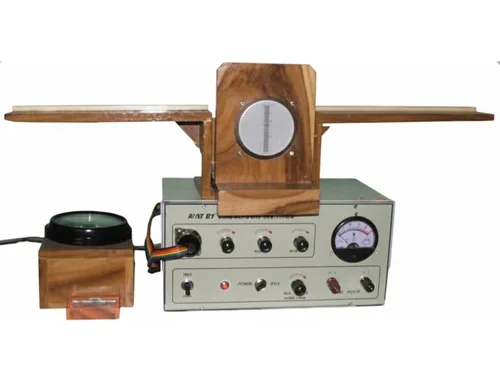
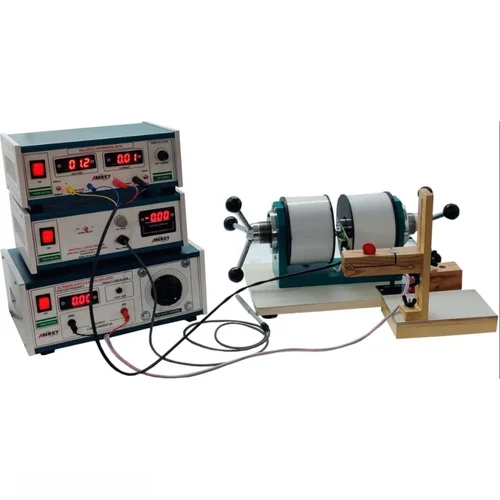
A Hall effect experiment setup is a vital educational equipment designed to help students and researchers study one of the most important phenomena in solid-state physics, the Hall effect. This setup is widely used in physics and electronics laboratories for demonstrating how a magnetic field applied perpendicular to the current in a conductor or semiconductor produces a measurable voltage, known as the Hall voltage. With its accurate and reliable design, the Hall effect experiment setup provides learners with a hands-on platform to explore key concepts such as carrier concentration, mobility of charge carriers, and the polarity of charge carriers in materials. It is considered an indispensable teaching tool in higher education institutions as it bridges theoretical concepts of semiconductor physics with practical experimentation, enabling students to understand the working principles behind modern devices like magnetic sensors, transducers, and integrated circuits.
Description
A Hall effect setup is an essential laboratory apparatus used to study the interaction between electric current and magnetic fields in conductive and semiconductor materials. It enables students to measure Hall voltage accurately when a current flows through a sample placed in a uniform magnetic field. Because this experiment connects theory with measurable outcomes, it helps learners understand the fundamental relationship between current, magnetic field strength, and charge carriers. Moreover, the setup supports clear observation of semiconductor behavior through controlled and repeatable experiments.
Hall Effect Setup for Semiconductor Characterization
The Hall effect setup typically includes a Hall probe or semiconductor sample, a regulated power supply, a high-sensitivity digital voltmeter or galvanometer, and an electromagnet. Students vary the current and magnetic field to observe corresponding changes in Hall voltage. Therefore, they can determine whether a semiconductor is p-type or n-type. In addition, the setup allows estimation of charge carrier density, which is a key parameter in electronics and semiconductor physics. Consequently, learners gain practical insight into material properties that influence device performance.
Understanding Sensors and Real-World Applications
A Hall effect setup helps students relate laboratory experiments to real-world technologies. The principles demonstrated form the basis of Hall effect sensors used in automotive systems, industrial automation, robotics, and consumer electronics. By performing these experiments, learners see how magnetic fields enable position sensing, speed detection, and current measurement. As a result, conceptual clarity improves and problem-solving skills develop, which prepares students for advanced studies and applied engineering fields.
Design, Accuracy, and Educational Value
Manufacturers design the Hall effect setup with durable components to ensure accuracy and long service life. The compact layout and clear connections make operation simple, even for beginners. Instructors benefit from its visual and quantitative demonstration of abstract concepts, which enhances classroom teaching. Because the setup supports both introductory and advanced experiments, it suits physics and electronics laboratories alike. For related laboratory instruments and teaching equipment, you may explore:
https://www.aseducationalkits.com/products-category/physics-lab-equipment/
For a broader range of laboratory and electronics education solutions, professionals can also refer to:
https://interlabs.in/products-catalogue/
Applications
Hall voltage measurement experiments
Identification of p-type and n-type semiconductors
Estimation of charge carrier density
Study of magnetic field effects in materials
Training in semiconductor physics and electronics