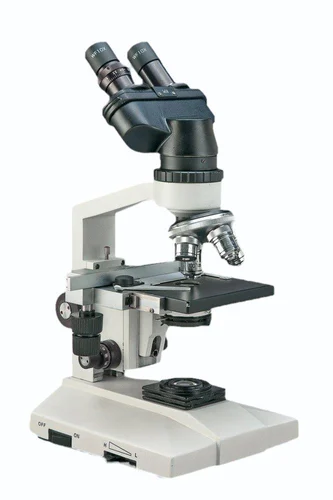
The research binocular microscope is a high-precision educational instrument designed to meet the advanced observational and documentation needs of academic laboratories, research institutions, and higher education facilities. It serves as a critical tool for detailed microscopic analysis in disciplines such as biology, biotechnology, microbiology, pathology, materials science, and life sciences. Designed with a rigid single-mould structure, the microscope offers excellent mechanical stability, which is essential for accurate observation during prolonged research and laboratory sessions. The ergonomic arm design with an integrated viewing window allows for easy handling and transport within laboratory environments, supporting both routine use and advanced experimental work. Its binocular viewing system provides comfortable, strain-free observation, enabling researchers and students to examine specimens for extended periods while maintaining precision and focus.
Description
A binocular research microscope is a high-precision optical instrument designed for advanced teaching and research applications. Its engineered optical system delivers high-resolution, distortion-free images, which supports accurate observation at cellular and subcellular levels. Because wide-field eyepieces provide a broad field of view, users can examine fine structural details with clarity. Moreover, the binocular configuration ensures comfortable viewing during extended laboratory sessions, making it suitable for academic and research environments.
Binocular Research Microscope for High-Magnification Analysis
The binocular research microscope supports high magnification through multiple objective lenses mounted on a smooth revolving nosepiece with precise click stops. This design enables quick and accurate magnification changes during observation. Therefore, students and researchers can transition seamlessly from low to high magnification for progressive analysis and comparative study. The precise alignment of objectives ensures consistent image quality across all magnification levels, which is essential for detailed specimen examination.
Precision Focusing and Mechanical Stage Control
A co-axial coarse and fine focusing mechanism provides accurate vertical movement of the stage. The finely graduated fine focus allows precise adjustments required for high-magnification and research-grade work. In addition, a ball bearing–driven mechanical stage offers smooth and accurate X–Y movement. Because stable slide positioning reduces drift, users can scan specimens methodically and document specific regions of interest with confidence.
Illumination, Ergonomics, and Laboratory Reliability
The binocular research microscope features built-in LED illumination with adjustable intensity control, which ensures uniform lighting and enhanced contrast. Low heat output protects delicate specimens during prolonged observation. An integrated battery backup supports uninterrupted operation during power fluctuations. The Abbe condenser with iris diaphragm allows precise control of light and contrast for different specimen types. Furthermore, the ergonomic design supports adjustable interpupillary distance for user comfort. For complementary laboratory equipment and teaching tools, you may explore:
https://www.aseducationalkits.com/products-category/physics-lab-equipment/
For a broader range of laboratory and research instruments, professionals can also refer to:
https://interlabs.in/products-catalogue/
Applications
Advanced biology and life science research
Cellular and subcellular specimen analysis
Teaching laboratories and postgraduate training
Clinical and academic microscopy studies
Documentation and comparative specimen analysis