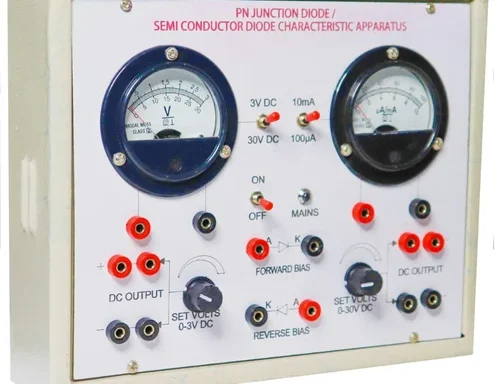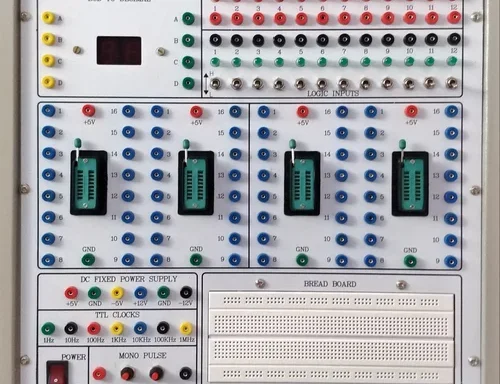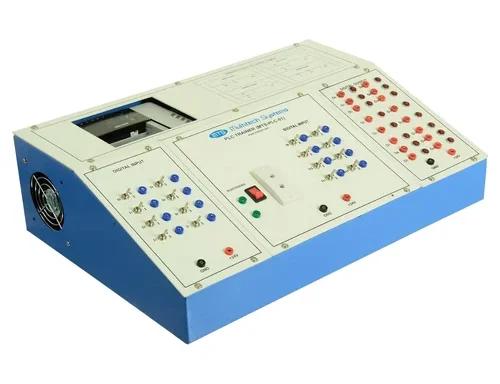
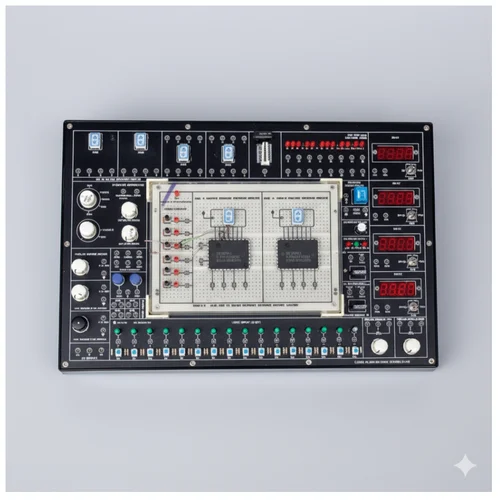
An electronics training kit is a comprehensive educational equipment designed to provide students, educators, and trainees with practical experience in understanding the fundamental principles of electronics and circuit design. These kits serve as a valuable resource in laboratories, technical institutes, vocational training centers, and engineering colleges where hands-on learning is considered essential to build a strong foundation in the field of electronics. With the rapid advancement of technology, the importance of practical exposure has grown significantly, and an electronics training kit plays a vital role in bridging the gap between theoretical knowledge and real-world applications. It allows learners to visualize, construct, and test various electronic circuits, giving them the opportunity to develop essential technical skills that are highly relevant in both academic and professional environments.
Description
An Electronics Training Kit is an educational platform designed to help students understand the principles of analog and digital electronics through hands-on experiments. It provides a structured environment where learners can build circuits, test components, and observe electronic behavior in real time. Because practical experimentation improves technical understanding, this kit helps bridge the gap between theoretical electronics concepts and real-world applications.
Key Features of the Electronics Learning System
- Integrated regulated power supply for circuit experiments
- Breadboard area for easy circuit assembly without soldering
- Includes components such as resistors, capacitors, transistors, diodes, and LEDs
- Built-in modules for logic gates, counters, flip-flops, and registers
- Supports both analog and digital electronics experiments
- Test points and connectors for measurement and signal analysis
Applications of Electronics Training Kit in Laboratories
The Electronics Training Kit allows students to perform a wide range of experiments related to analog and digital circuit design. Learners can build amplifier circuits, oscillators, rectifiers, and filters for analog studies. At the same time, digital experiments such as logic gate operations, Boolean algebra circuits, and sequential logic systems can also be explored, helping students understand the working principles of electronic systems.
Importance in Engineering and Technical Education
The Electronics Training Kit plays an important role in developing practical electronics skills. Students learn how to assemble circuits, troubleshoot faults, and analyze electrical signals using measurement tools. As a result, learners gain confidence in designing and testing circuits used in communication devices, automation systems, and electronic instruments.
For related laboratory and educational equipment, you may explore:
https://www.aseducationalkits.com/products-category/physics-lab-equipment/
For a broader range of laboratory and analytical solutions, professionals can also refer to:
https://interlabs.in/products-catalogue/