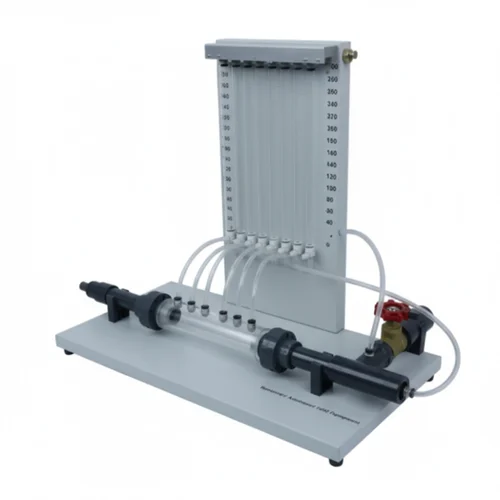
Pressure Distribution In A Venturi Nozzle – Engineering Training System (AS-INT-TVET-DVET-014)The Pressure Distribution In A Venturi Nozzle apparatus is designed to study the pressure variations along a converging-diverging channel representing a venturi nozzle, a key component in fluid mechanics and hydraulic engineering curricula. This equipment is widely used in polytechnic and engineering colleges worldwide and complies with specifications set by major international funding bodies like the World Bank, Asian Development Bank (ADB), and African Development Bank (AfDB).
Description
A Pressure Distribution In A Venturi Nozzle apparatus is used in fluid mechanics laboratories to study how pressure and velocity change when fluid flows through a varying cross-section channel. The system demonstrates fundamental principles of fluid acceleration and pressure drop based on Bernoulli’s theorem. Therefore, students can observe how pressure decreases as velocity increases in a venturi nozzle.
Key Features of the Venturi Flow Apparatus
- Transparent flow channel with variable cross-section for observing fluid movement
- Twelve-tube manometer system for measuring static pressure at multiple points
- Inlet and outlet tanks to maintain steady pressure conditions
- Dye injection facility for visualizing flow patterns and streamlines
- Strong frame and durable construction suitable for laboratory use
Applications of Pressure Distribution In A Venturi Nozzle
The Pressure Distribution In A Venturi Nozzle setup allows students to measure pressure variation along the length of the nozzle using the multi-tube manometer. In addition, learners can visualize streamline patterns by injecting dye into the flow channel. As a result, students can relate theoretical calculations with actual experimental observations in fluid mechanics studies.
Importance in Fluid Mechanics Education
The Pressure Distribution In A Venturi Nozzle apparatus helps learners understand the relationship between pressure, velocity, and cross-sectional area in fluid flow. Furthermore, it supports experiments related to Bernoulli’s principle and energy conversion in hydraulic systems. Consequently, engineering students gain practical experience in data measurement, pressure analysis, and fluid dynamics experiments.
For related laboratory and educational equipment, you may explore:
https://www.aseducationalkits.com/products-category/physics-lab-equipment/
For a broader range of laboratory and analytical solutions, professionals can also refer to:
https://interlabs.in/products-catalogue/