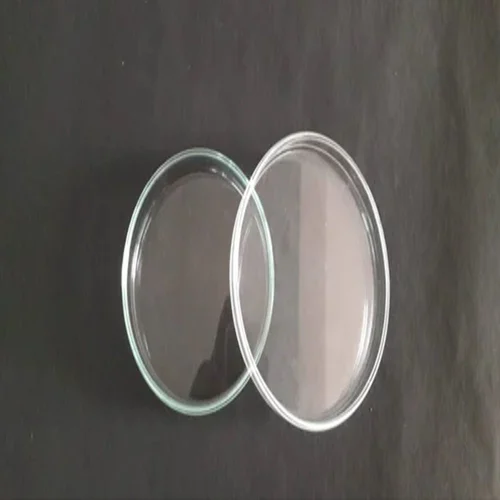
Glass Petri dishes are essential lab tools for culturing microorganisms (bacteria, fungi) on growth media like agar, testing antibiotic effectiveness, growing plant/animal cells, food safety checks, and educational demos, offering a clear, reusable, sterilizable environment for observation in microbiology, biotech, and research.
Description
A Glass Petri Dish is a widely used laboratory container designed for culturing microorganisms and conducting biological experiments. It consists of a shallow cylindrical dish with a matching lid that helps create a controlled environment for microbial growth. Therefore, laboratories across microbiology, biotechnology, and research fields rely on this simple yet highly effective tool.
Structure and Material Advantages
The Glass Petri Dish is typically manufactured from high-quality heat-resistant glass that offers excellent transparency and durability. Because the glass material withstands high temperatures, it can be sterilized using autoclaves or dry heat sterilization. This makes the dish reusable and suitable for repeated laboratory experiments.
Moreover, the clear glass surface allows researchers and students to easily observe microbial colonies, growth patterns, and experimental reactions without opening the dish. As a result, contamination risks remain minimal while observations remain accurate.
Applications in Microbiology and Biotechnology
The Glass Petri Dish plays a central role in microbiology laboratories. Scientists use it to culture bacteria, fungi, and other microorganisms on nutrient media such as agar. In addition, researchers conduct antibiotic sensitivity tests by placing antibiotic discs on cultured bacteria to observe inhibition zones.
Furthermore, biotechnology laboratories use petri dishes to grow plant and animal cells in controlled conditions. Food safety laboratories also rely on these dishes to detect microbial contamination in food samples. Consequently, the petri dish becomes an essential tool for scientific research, diagnostics, and quality control testing.
Importance in Education and Scientific Research
The Glass Petri Dish is also widely used in educational institutions for laboratory demonstrations and practical training. Students learn basic microbiological techniques such as streak plating, colony isolation, and microbial observation. Because the dish provides a sterile and contained environment, it allows safe handling of microorganisms during experiments.
In addition, petri dishes support environmental and medical research where scientists analyze microbial behavior and growth patterns. Their versatility and ease of use make them indispensable for both beginner-level laboratory training and advanced scientific investigations.
Durability and Reusability Benefits
Unlike disposable plastic alternatives, the Glass Petri Dish offers long-term usability. Its strong construction allows repeated sterilization and cleaning without losing clarity. Consequently, laboratories benefit from cost-effective operation while maintaining high experimental standards.
By providing a sterile and visible environment for microbial growth, the glass petri dish continues to play a vital role in scientific discovery and laboratory education.
For related laboratory and educational equipment, you may explore:
https://www.aseducationalkits.com/products-category/physics-lab-equipment/
For a broader range of laboratory and analytical solutions, professionals can also refer to:
https://interlabs.in/products-catalogue/