Explore the fascinating world of metallurgy and industrial chemistry with this educational Blast Furnace Model. Specially designed for school science labs and STEM exhibitions, this model offers an insightful demonstration of how iron is extracted from its ores in a blast furnace setup. The structure visually represents every key section of a real-life blast furnace including the hearth, bosh, stack, and furnace top.
Description
The Blast Furnace Model is an educational working model designed to help students understand the ironmaking and smelting process used in large-scale metallurgical industries. It visually demonstrates how raw materials such as iron ore, coke, and limestone are processed inside a blast furnace to produce molten iron. Therefore, it serves as an effective teaching aid for explaining complex industrial processes in a simplified and engaging way.
Structure and Working Principle of the Blast Furnace Model
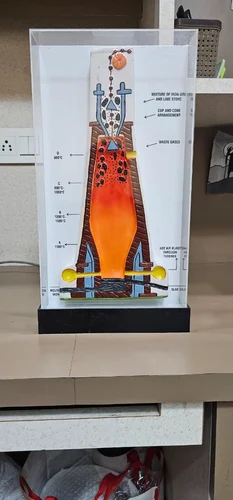
The Blast Furnace Model accurately represents the internal structure and working mechanism of a real blast furnace. It includes a clearly illustrated cup and cone charging system, which shows how raw materials are introduced from the top of the furnace. As the materials move downward, hot air is blasted from the lower section to ignite the coke and increase the temperature inside the furnace.
This model also highlights the concept of hot air blasting, where preheated air enters through the bottom section of the furnace. Because the internal temperature can reach around 1800°C, chemical reactions occur that reduce iron ore into molten iron while separating slag as a byproduct. Consequently, students can observe the complete transformation of raw materials into usable metal.
Visual Representation of Metallurgical Zones
The Blast Furnace Model includes different furnace zones that represent temperature gradients and reduction stages. These zones help explain how various chemical reactions occur at different heights inside the furnace. In addition, the model displays waste gas outlets and reaction chambers where carbon monoxide reduces iron oxides.
The transparent design of the model allows students to observe internal sections clearly. As a result, teachers can demonstrate the movement of materials and gases through the furnace while explaining metallurgical principles.
Educational Value and Classroom Applications
The Blast Furnace Model is widely used in schools, science laboratories, and educational exhibitions. It supports lessons on metallurgy, thermodynamics, and industrial chemistry. Because it provides a visual representation of the iron extraction process, students can better understand topics covered in middle and senior school science curricula.
Furthermore, the model promotes experiential learning by encouraging students to explore how industrial systems operate. Teachers can also use it during science fairs, workshops, and classroom demonstrations to explain the importance of iron production in modern industries.
Durable Design and Practical Use
The Blast Furnace Model is constructed from durable plastic and mounted on a strong base for stability. Its approximate dimensions of 42 × 6 × 42 centimeters make it compact yet detailed enough for effective demonstration. With a weight of about 823 grams, the model remains lightweight and easy to handle.
Because no assembly is required, educators can use it immediately for classroom demonstrations. Moreover, its vivid detailing enhances visibility, allowing students to clearly identify different furnace components.
Importance in STEM Education
The Blast Furnace Model helps bridge the gap between theoretical learning and real industrial processes. It introduces students to the principles of material science, chemical reactions, and energy transfer within large industrial systems. Consequently, it inspires curiosity about metallurgy, engineering, and environmental aspects of manufacturing industries.
By simplifying complex concepts into a clear visual format, the model improves student engagement and knowledge retention. Therefore, it becomes an invaluable resource for science educators aiming to make industrial chemistry and metallurgy easier to understand.
For related laboratory and educational equipment, you may explore:
https://www.aseducationalkits.com/products-category/physics-lab-equipment/
For a broader range of laboratory and analytical solutions, professionals can also refer to:
https://interlabs.in/products-catalogue/