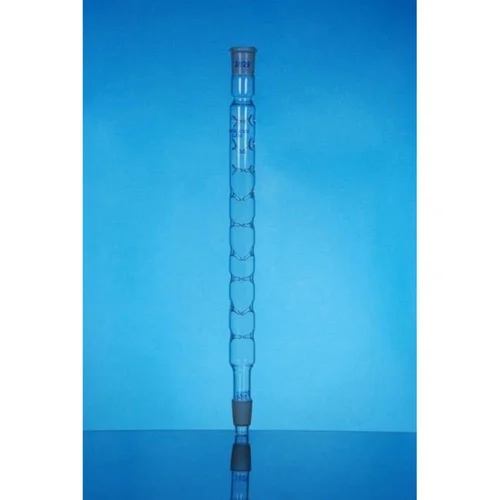
Fractional columns in labs separate liquid mixtures with close boiling points through repeated vaporization and condensation, essential for purifying chemicals, recovering solvents, and creating pure components for pharmaceuticals, flavors, and petrochemicals, acting as a crucial tool in chemical analysis and research by providing highly pure fractions based on volatility. They work by providing a large surface area (packing/trays) for vapor-liquid contact, creating a temperature gradient where lighter components rise and heavier ones condense, effectively allowing for multiple “simple distillations” in one apparatus.
Description
Introduction to Fractional Column Laboratory
Fractional Column Laboratory apparatus is an essential instrument used in chemistry laboratories for separating liquid mixtures with close boiling points. Scientists and students commonly use this apparatus during fractional distillation experiments to obtain pure chemical components.
The column works by allowing repeated vaporization and condensation inside a packed vertical structure. As a result, mixtures separate based on differences in volatility and boiling points. This process enables researchers to collect purified fractions from complex liquid mixtures.
Chemistry laboratories, research institutes, and educational institutions widely use this apparatus for chemical purification, solvent recovery, and analytical experiments. Therefore, it plays a vital role in laboratory-scale separation techniques.
Working Principle of Fractional Column Laboratory
The apparatus operates on the principle of fractional distillation. When a liquid mixture is heated, vapors rise through the vertical column.
Inside the column, packing materials or trays provide a large surface area for vapor and liquid interaction. Consequently, vapors repeatedly condense and re-evaporate while moving upward through the column.
A temperature gradient develops along the column height. Lighter components with lower boiling points rise toward the top. Meanwhile, heavier components condense and return to the lower sections.
Through this repeated process, the column performs multiple simple distillations within a single apparatus. As a result, laboratories can obtain highly purified chemical fractions.
Applications of Fractional Column Laboratory
Chemistry laboratories widely use this apparatus to separate mixtures of organic liquids with similar boiling points. Researchers often apply it during chemical purification and compound isolation.
Pharmaceutical laboratories rely on this method to produce pure chemical intermediates used in drug development. Additionally, chemical research laboratories use fractional distillation to analyze complex mixtures.
The apparatus also supports solvent recovery processes. Consequently, laboratories can reuse valuable solvents while maintaining experimental efficiency.
Features
This laboratory apparatus includes several features that improve separation efficiency during distillation.
Firstly, the column structure provides a large surface area for vapor-liquid interaction. Secondly, packing materials enhance repeated condensation and evaporation cycles.
Key features include:
- Efficient fractional distillation mechanism
- Packed column for increased vapor-liquid contact
- Suitable for separating liquids with close boiling points
- Compatible with standard laboratory distillation setups
- Durable glass construction for laboratory use
These features help laboratories obtain high-purity chemical fractions.
Educational Importance
Fractional distillation is an important concept in chemistry education. Therefore, laboratories use this apparatus to demonstrate separation techniques in practical sessions.
Students learn how boiling point differences influence separation of chemical mixtures. Moreover, they observe how temperature gradients affect vapor movement inside the column.
Consequently, this apparatus helps learners understand purification techniques used in chemical analysis. Many laboratories integrate such equipment with other scientific apparatus available here:
https://www.aseducationalkits.com/products-category/physics-lab-equipment/
Industrial Uses
Fractional distillation plays a crucial role in many industrial chemical processes. Petrochemical industries use similar columns to separate crude oil into different fractions.
Pharmaceutical and chemical industries also rely on fractional separation to produce pure compounds. Additionally, laboratories use fractional columns for research and quality control testing.
Further laboratory instruments and scientific equipment catalogues can also be explored here:
https://interlabs.in/products-catalogue/
Conclusion
Fractional Column Laboratory apparatus is a key device for separating liquid mixtures with close boiling points. Its ability to perform repeated vaporization and condensation allows efficient purification of chemicals.
Therefore, it remains an essential tool for chemistry education, laboratory research, and industrial chemical analysis.