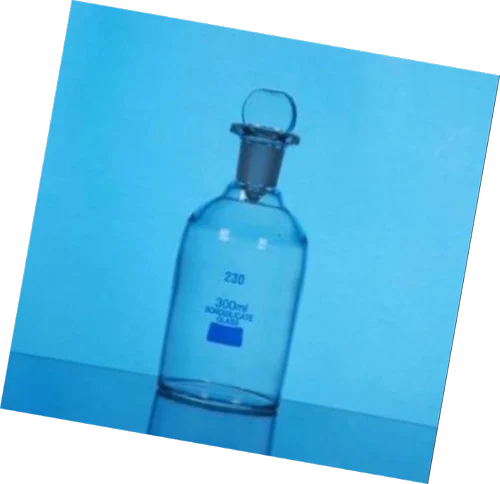
Glass BOD (Biochemical Oxygen Demand) bottles are specialized lab containers used for environmental monitoring, primarily to measure the oxygen used by microbes breaking down organic matter in water samples (sewage, wastewater, rivers) over 5 days, indicating pollution levels, featuring airtight stoppers and unique shapes to prevent air leaks during incubation. They’re vital for assessing water quality, wastewater treatment effectiveness, and ecosystem health, made from durable borosilicate glass to resist thermal shock.
Description
Introduction to Glass BOD Bottles
Glass BOD Bottles are specialized laboratory containers used for measuring biochemical oxygen demand in water samples. Environmental laboratories widely use these bottles to evaluate the amount of dissolved oxygen consumed by microorganisms while decomposing organic matter in water.
These bottles are designed with airtight glass stoppers to prevent air exchange during testing. As a result, the dissolved oxygen level inside the bottle remains unchanged except for microbial activity. The bottles are usually made from borosilicate glass, which offers excellent resistance to thermal shock and chemical reactions.
Because of their accuracy and durability, laboratories use these bottles for monitoring water pollution, testing wastewater treatment efficiency, and studying environmental health.
Working Principle of Glass BOD Bottles
The bottles work based on the biochemical oxygen demand testing method. A water sample is placed inside the bottle and sealed with an airtight stopper.
Microorganisms present in the sample begin decomposing organic matter. Consequently, they consume dissolved oxygen during the process. Scientists measure the oxygen level initially and again after a five-day incubation period.
The reduction in oxygen concentration indicates the biochemical oxygen demand of the sample. As a result, laboratories can determine the level of organic pollution present in water sources.
Applications of Glass BOD Bottles
Environmental laboratories commonly use these bottles for testing water quality in rivers, lakes, and reservoirs. The test helps scientists determine pollution levels caused by organic waste.
Wastewater treatment plants also use these bottles to monitor treatment efficiency. Moreover, environmental monitoring agencies rely on BOD tests to ensure that water bodies meet safety standards.
Educational institutions frequently include these bottles in environmental science and microbiology laboratories for practical demonstrations.
Features
These laboratory bottles include several features that support accurate water quality testing.
Firstly, the borosilicate glass construction ensures excellent thermal resistance. Secondly, the airtight stopper prevents oxygen contamination during incubation.
Key features include:
- High-quality borosilicate glass construction
- Airtight stopper for precise oxygen measurement
- Suitable for biochemical oxygen demand testing
- Resistant to thermal shock and chemical reactions
- Durable design for repeated laboratory use
These features make the bottles reliable for environmental testing and laboratory research.
Educational Importance
Environmental science education requires practical water quality analysis. Therefore, laboratories use these bottles to demonstrate biochemical oxygen demand testing.
Students learn how microbial activity affects dissolved oxygen levels in water. Moreover, they understand how pollution influences aquatic ecosystems.
Consequently, this experiment helps learners develop a deeper understanding of environmental monitoring and water pollution control. Educational institutions can also explore related laboratory kits here:
https://www.aseducationalkits.com/products-category/ncert-educational-kits/
Industrial Uses
Industries and environmental monitoring agencies rely on BOD testing to assess wastewater discharge. Manufacturing plants and municipal treatment facilities regularly analyze wastewater samples using these bottles.
The test helps industries ensure compliance with environmental regulations. Additionally, research laboratories use these bottles to study aquatic ecosystems and pollution control methods.
Training equipment and laboratory systems related to technical education can also be explored here:
https://interlabs.in/product-category/training-and-skill-development/
For additional laboratory glassware collections and advanced scientific glass products, refer to:
https://www.iwaki-pyrex.com/products/
Conclusion
Glass BOD Bottles are essential laboratory containers used for measuring biochemical oxygen demand in water samples. Their airtight design, borosilicate glass construction, and precise measurement capability make them ideal for environmental testing.
Therefore, they remain important tools for water quality monitoring, wastewater treatment evaluation, and environmental research.